
<p><em>By The Cakani Law Firm, P.C. | October 21, 2026</em></p>
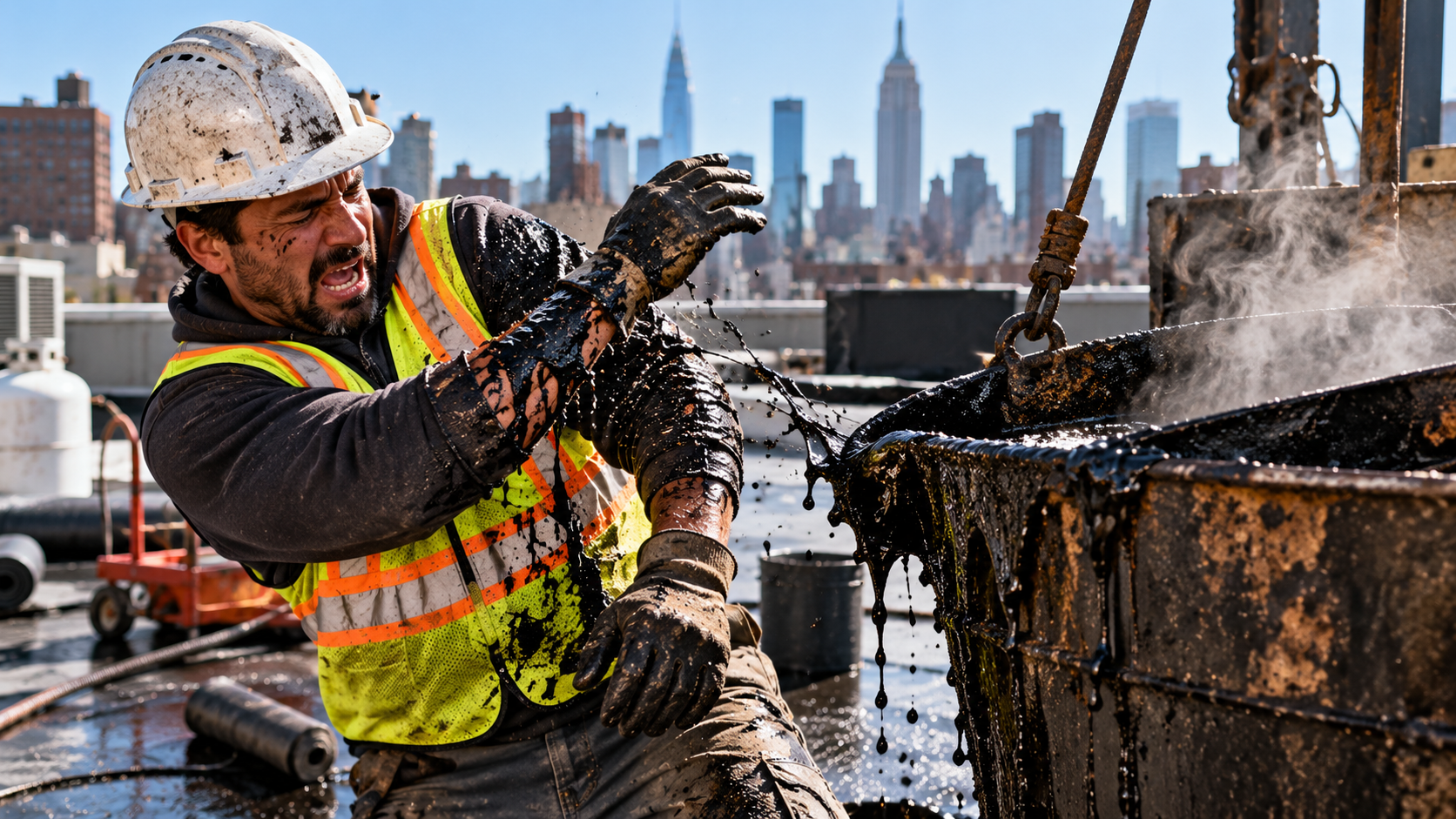
<p>Hot tar is one of the most dangerous materials on a New York construction site. Roofing asphalt is heated to roughly 400 to 525 degrees Fahrenheit, and it sticks to skin, holding that heat against the body long after it lands. A splash can cause deep second- and third-degree burns in seconds. Once applied, the same tar turns a roof surface into a slipping and tripping hazard.</p>
<p>At The Cakani Law Firm, P.C., we represent roofers, laborers and other construction workers injured in hot tar accidents across New York City, Westchester and the surrounding counties. This post explains how these injuries happen, which New York laws protect injured workers, and what to do if you or a family member has been hurt.</p>
<h2>How Hot Tar Burns Happen on New York Job Sites</h2>
<p>Most hot tar burns are not freak accidents. They happen when the equipment, the procedures or the protective gear fall short. Common scenarios include:</p>
<ul>
<li><strong>Tanker and pump line failures:</strong> Tar is pumped from a heated tanker truck up through pipes and hoses to the roof. A loose coupling, a leaking seam or a pump switched on at the wrong moment can spray molten tar at the worker connecting the line.</li>
<li><strong>Hot luggers and kettles:</strong> Insulated containers and kettles that hold heated tar can boil over, blow back or tip if they are overfilled, poorly maintained or missing required safety features.</li>
<li><strong>Open buckets and hoisting:</strong> Carrying or hoisting open buckets of hot tar by hand or by rope invites spills onto the worker below or beside the load.</li>
<li><strong>Mopping and application:</strong> Workers mopping tar onto a roof deck can be splashed, or can slip and plunge a hand or arm into a mop cart.</li>
<li><strong>Missing protective equipment:</strong> Without a face shield, heat-resistant gloves and long sleeves, a small splash can become a disfiguring injury to the face, eyes, neck and hands.</li>
</ul>
<p>Tar burns often require burn-unit care, skin grafts and months of treatment. Eye injuries and permanent scarring are common. Never try to peel hardened tar off a burn yourself; let medical staff remove it.</p>
<h2>A Case From Our Files: A Tar Tanker Burn in the Bronx</h2>
<p>Our firm currently represents a roofer who was badly burned on a large residential roofing project in the Bronx. The facts below come from the public court record; we do not identify our client.</p>
<p>Our client was assigned to connect the pipes that carried hot tar from a heated tanker truck up to the roof. While he was standing on the truck with his hands on the pipe, a co-worker activated the pump. Tar heated to about 525 degrees blasted out of the line, striking his face, neck, chest, hands and right eye.</p>
<p>He testified that no face shields were available anywhere on the project, and that he had asked his supervisor for one several times, only to be told the crew used safety glasses. Witnesses for the contractors testified that the pump and compressor should have been shut down and the line cooled before anyone worked on it, and that no one should have been near the controls. The NYC Department of Buildings issued a stop-work order after the accident.</p>
<p>In May 2025, the Bronx County Supreme Court ruled on competing summary judgment motions. Key takeaways included:</p>
<ul>
<li><strong>Labor Law § 241(6):</strong> The claim survived. The court held that the Industrial Code’s eye-protection rule, 12 NYCRR § 23-1.8(a), was specific enough to support a claim, and that a jury should decide whether hot asphalt is a corrosive substance requiring protective apparel under § 23-1.8(c)(4).</li>
<li><strong>Labor Law § 200 and negligence:</strong> These claims survived because testimony about the general contractor’s and construction manager’s ability to stop unsafe work raised questions about supervision and control.</li>
<li><strong>Construction manager:</strong> The construction manager remained in the case despite contract language disclaiming safety responsibility, because a question remained about whether it acted as the owner’s agent.</li>
<li><strong>Labor Law § 240(1):</strong> The Scaffold Law claim was dismissed because the injury did not involve a fall or a falling object.</li>
</ul>
<p>The case is headed toward trial, and the defendants have filed an appeal. It shows how a burn case is built: by documenting missing protective gear, unsafe procedures and who had the power to stop the work.</p>
<h2>Slipping and Tripping on Tar</h2>
<p>Tar does not stop being dangerous once it is on the roof. Fresh or dripped tar is slick and sticky, and roofing jobs leave the work surface cluttered. Workers can be hurt when they:</p>
<ul>
<li>Slip on fresh or spilled tar, or on primer, while carrying hot buckets or mopping.</li>
<li>Step into wet tar and lose their footing, falling into a mop cart, kettle or bucket.</li>
<li>Trip over hardened tar globs, torn-off roofing, membrane rolls, hoses or tools left in walkways.</li>
<li>Fall on tar-coated ladders, stairs or hatches leading to the roof.</li>
</ul>
<p>These falls are often doubly harmful: the worker suffers fall injuries to the back, knees, shoulders or head and, if hot tar is nearby, serious burns as well. In one reported New York case, a roofer slipped on tar that had dripped from a mop and plunged his arm into a cart of hot tar. Workplace safety studies also describe apprentices slipping on freshly applied tar and falling into it.</p>
<p>New York’s Industrial Code requires that floors, platforms and similar footing be kept free of slippery substances like grease and other foreign material, and that passageways and work areas be kept clear of debris and tripping hazards. When a contractor or owner lets tar, debris or materials pile up underfoot, the injured worker may have a claim.</p>
<h2>New York Laws That Protect Injured Roofers</h2>
<h3>Labor Law § 241(6)</h3>
<p>This law requires owners and general contractors to comply with specific Industrial Code safety rules. In tar cases, relevant provisions may include:</p>
<ul>
<li><strong>12 NYCRR § 23-1.8(a):</strong> Eye protection for workers exposed to eye hazards.</li>
<li><strong>12 NYCRR § 23-1.8(c)(4):</strong> Protective apparel for certain corrosive substances.</li>
<li><strong>12 NYCRR § 23-1.24:</strong> Safety requirements for hot roofing equipment.</li>
<li><strong>12 NYCRR § 23-1.7(d) and (e):</strong> Protection against slipping hazards and unsafe passageways or work areas.</li>
</ul>
<p>Whether a particular provision applies depends on the facts of the accident and the specific safety requirements involved.</p>
<h3>Labor Law § 200</h3>
<p>This law addresses the duty of owners and contractors to provide a reasonably safe workplace. It may apply when a party controlled the unsafe work method or knew about a dangerous condition, such as tar left on a walkway.</p>
<h3>Labor Law § 240(1) — The Scaffold Law</h3>
<p>This law addresses certain gravity-related risks, including falls from heights and injuries caused by falling objects. It may apply when a roofing worker falls from an elevated work area or is struck by a falling object, such as a bucket of tar dropping from a hoist. A burn caused by a spray of hot tar at ground level generally does not qualify on that basis alone.</p>
<p>Under Labor Law §§ 241(6) and 240(1), qualifying duties are non-delegable. A property owner or general contractor may be held responsible even when a subcontractor caused the hazard. Under § 241(6), a worker’s own carelessness may reduce a recovery but does not automatically bar it.</p>
<h2>Workers’ Compensation Is Not Your Only Option</h2>
<p>If you were hurt on the job, you may be entitled to workers’ compensation benefits. However, workers’ compensation does not pay for pain and suffering, scarring or disfigurement, and it limits lost-wage benefits. In most cases, you cannot sue your own employer.</p>
<p>You may be able to bring a separate lawsuit against other parties whose negligence or Labor Law violations contributed to the accident. Depending on the project, these parties may include:</p>
<ul>
<li>The property owner, including public owners such as housing authorities and city agencies.</li>
<li>The general contractor.</li>
<li>A construction manager acting as the owner’s agent.</li>
<li>Other subcontractors working on the site.</li>
<li>Manufacturers of defective kettles, tankers, pumps, hoses or couplings.</li>
</ul>
<p>A third-party lawsuit may provide compensation for burns, scarring and lost earning capacity that workers’ compensation does not cover. The workers’ compensation carrier may have a lien on that recovery, which an experienced law firm can negotiate as part of the case.</p>
<h2>What to Do After a Tar Burn or Fall</h2>
<ol>
<li><strong>Get medical care immediately.</strong> Cool the burn with water and go to an emergency room or burn unit. Do not try to remove the tar yourself.</li>
<li><strong>Report the accident.</strong> Tell your supervisor and make sure the incident is documented in writing.</li>
<li><strong>Document the scene.</strong> If you can do so safely, photograph the equipment, hoses, spilled tar, debris and protective gear that was or was not provided.</li>
<li><strong>Get witness information.</strong> Record the names and contact information of co-workers, foremen and safety managers who witnessed the accident.</li>
<li><strong>Keep your records.</strong> Save medical bills, photographs of your injuries as they heal and pay stubs.</li>
<li><strong>Speak with a construction accident lawyer.</strong> Consider getting legal advice before giving recorded statements to an insurance company.</li>
</ol>
<p><strong>Deadlines matter.</strong> Most personal injury lawsuits in New York must be filed within three years. If the property owner is a public entity, such as the City of New York or NYCHA, a Notice of Claim generally must be filed within 90 days of the accident. Exceptions and other deadlines may apply, so seek legal advice promptly.</p>
<h2>Talk to a New York Construction Accident Lawyer</h2>
<p>If you were burned by hot tar or hurt in a fall on a tar-covered roof, The Cakani Law Firm, P.C. can help. We handle Labor Law and construction injury cases from our offices in White Plains, Manhattan and Englewood Cliffs, New Jersey, and we work on a contingency basis: no fee unless we recover for you.</p>
<p>Call us at <strong><a href=”tel:12129620500″>(212) 962-0500</a></strong> or visit <a href=”https://cakanilaw.com/”>cakanilaw.com</a> to request a free consultation.</p>
<p><em>Attorney Advertising. This article is for general informational purposes only and is not legal advice. Reading it does not create an attorney-client relationship. Prior results do not guarantee a similar outcome.</em></p>

