
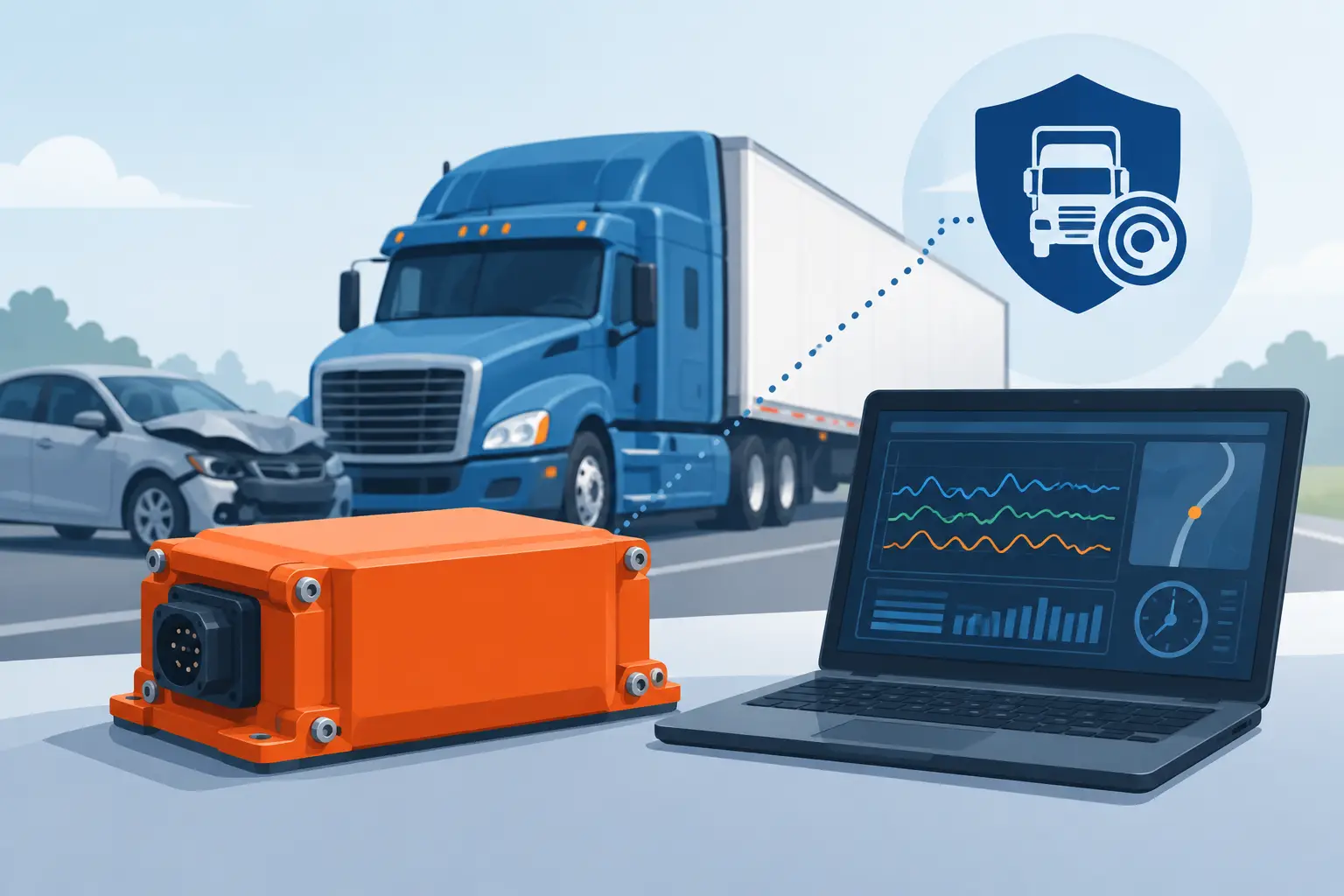
A tractor-trailer can travel hundreds of feet after a driver reacts to danger. In the seconds before impact, truck accident black box evidence may record whether the driver braked, how fast the truck was moving, whether cruise control was active, and other facts that can cut through competing stories about what happened.
For an injured driver, passenger, pedestrian, cyclist, or grieving family, those records can matter enormously. The trucking company may have investigators working immediately after a serious collision. You deserve someone working just as quickly to protect evidence before it is overwritten, lost, or explained away.
What Is a Truck’s Black Box?
“Black box” is a common term, but commercial trucks do not necessarily have one single device that captures every detail of a crash. Many trucks have an event data recorder, an engine control module, an electronic logging device, telematics equipment, dash cameras, or several of these systems working together.
The available data depends on the truck’s make, model, age, and equipment. Some systems preserve only a brief window of information around a sudden braking event or collision. Others may retain location data, driver-hours records, inspection reports, or video for longer periods. That distinction matters because evidence can disappear quickly if no one acts.
A black box does not automatically prove that the truck driver caused the crash. It is one powerful piece of evidence. Its value comes from comparing it with physical damage, roadway markings, photographs, witness accounts, police findings, cell phone records, maintenance documents, and expert analysis.
What Truck Accident Black Box Evidence Can Reveal
In a serious truck crash, the central dispute often comes down to a few seconds: Was the truck traveling too fast? Did the driver brake? Did the driver have enough time and distance to avoid the collision? Was the driver operating beyond permitted hours?
Depending on the system, truck accident black box evidence may help answer questions such as these:
- The truck’s speed before impact and at impact
- Brake application, throttle position, steering input, and cruise-control use
- Sudden deceleration, hard braking, or collision-related events
- The truck’s route, location, and timing
- Hours of service and possible violations of rest requirements
- Vehicle warnings, mechanical faults, and maintenance-related issues
A speed reading alone is not the whole case. A defense lawyer may argue that another vehicle cut off the truck or that road conditions made a crash unavoidable. But when electronic data shows excessive speed, delayed braking, or hours of continuous driving, it can expose a version of events that a driver or insurer would rather minimize.
The Data Can Challenge a Driver’s Account
After a violent crash, it is common for people to remember events differently. Trauma affects memory. So does self-interest. A truck driver may say a passenger vehicle suddenly stopped, changed lanes, or entered an intersection without warning.
Electronic records can test that claim. If data shows the truck was speeding, following too closely, or failed to brake until the last moment, the issue becomes more than one person’s word against another’s. Accident reconstruction experts can use the data with scene evidence to determine whether the collision could have been avoided.
It Can Expose Company-Level Safety Failures
Truck cases are not always limited to the person behind the wheel. The trucking company may have pressured a driver to meet an unrealistic schedule, ignored repeated safety violations, failed to inspect equipment, or allowed a fatigued or unqualified driver on the road.
Electronic logs and telematics records may reveal patterns. A driver who appears to have exceeded hours-of-service limits, for example, may not have made an isolated mistake. The records may support a broader investigation into dispatch practices, supervision, training, and safety policies.
That is why high-stakes truck litigation requires more than a quick review of a police report. The responsible parties often control the critical documents and electronic systems. A serious case requires a firm prepared to demand the evidence, analyze it, and challenge the defense’s interpretation.
Why Fast Action Matters After a Truck Crash
Trucking companies are generally required to maintain certain records, but not forever. Data retention periods vary. Some crash-related information may be recorded over, deleted under routine practices, or removed when equipment is repaired, replaced, or returned to service.
The truck itself is evidence, too. Tire condition, brake components, lighting, underride guards, cargo securement, and damage patterns may help explain why the crash happened. Once the vehicle is repaired or dismantled, a meaningful inspection may no longer be possible.
An attorney can send a preservation demand, often called a spoliation letter, instructing the trucking company and other responsible parties to preserve the truck, electronic data, driver logs, onboard video, inspection records, maintenance files, dispatch communications, and other relevant material. Sending that notice does not guarantee cooperation. It does, however, put the company on formal notice that the evidence must not be destroyed.
In New York and New Jersey, the consequences of failing to preserve evidence can become a major issue in litigation. Courts may impose remedies when a party destroys evidence it had a duty to preserve. But no injured person should have to rely on a later court fight to recover data that could have been secured at the beginning.
The Defense Will Have Its Own Interpretation
A trucking insurer may acknowledge that data exists while arguing it means something very different from what you assume. For example, a recorded brake application does not necessarily establish timely braking. A system may record a speed at one point but not capture every movement leading to impact. GPS readings can have limitations. Data can also be incomplete or require specialized extraction.
That is where qualified experts matter. An accident reconstruction specialist may examine the vehicle, download the data using proper methods, preserve the chain of custody, and compare the information to the physical evidence. A trucking safety expert may evaluate whether the carrier followed federal and state safety requirements. Medical experts can connect the force of the collision to the life-altering injuries a victim now faces.
These cases are expensive to build correctly. They can involve multiple defendants, technical records, corporate insurance policies, and aggressive defense teams. The Cakani Law Firm, P.C. pursues serious injury and wrongful death cases with the resources to investigate the facts and confront powerful trucking companies and insurers.
What You Can Do After a Truck Accident
Your first priority is medical care. Some catastrophic injuries are immediately apparent, while traumatic brain injuries, spinal damage, internal injuries, and psychological trauma may become clearer over time. Follow medical advice and keep records of every appointment, symptom, work restriction, and expense.
If you can do so safely, preserve what is available to you. Save photographs, video, witness names, insurance information, and the police report number. Do not repair or dispose of your own damaged vehicle without first discussing whether it may be evidence. Avoid posting details of the crash or your injuries on social media while your claim is pending.
Be cautious with a trucking company’s insurer. An early call may sound helpful, but the insurer is gathering information to protect its financial interests. You do not have to give a recorded statement or accept a quick settlement before you understand the full extent of your injuries and the evidence supporting your claim.
A Case Is About More Than a Data Download
Black box data can be compelling, but no device captures the pain of a family suddenly facing surgeries, lost wages, mobility limits, or the death of someone they love. The purpose of a truck accident claim is not merely to identify a bad driving decision. It is to pursue compensation that reflects the medical care, income loss, personal suffering, and future uncertainty caused by a preventable crash.
If a truck crash changed your life, do not assume that the police report tells the full story or that the trucking company will preserve what matters. Prompt legal guidance can help protect the evidence while you focus on healing and moving forward.

