
The broken ladder may be replaced before your next shift. A construction site may look completely different within hours. A supervisor may describe the accident one way in a report while the security camera tells another story. That is why workplace injury evidence matters from the moment an accident happens.
If you were seriously hurt at work in New York or New Jersey, your first priority is medical care. But once you are safe, protecting the facts can make a major difference in your ability to pursue benefits and, in some cases, a claim against a negligent third party. Insurance companies, contractors, property owners, and employers often move quickly after a serious accident. You should not be left trying to reconstruct what happened after the proof is gone.
Why Workplace Injury Evidence Is So Important
A workplace accident is not always a simple workers’ compensation matter. Workers’ compensation may provide certain benefits regardless of fault, but it often does not cover the full cost of a catastrophic injury, lost earning capacity, pain and suffering, or the damage a family faces after a fatal accident.
In many cases, another party may be responsible. On a construction site, that could be a general contractor, property owner, subcontractor, equipment manufacturer, or outside vendor. A delivery driver could be injured because another motorist caused a crash. A warehouse worker could be hurt by a defective machine. The evidence must show not only that you were injured, but how the injury happened and who had a duty to prevent it.
Strong proof can establish that a ladder was defective, a floor was dangerously slick, a scaffold lacked required protection, a machine guard was missing, or a driver ignored the rules of the road. It can also counter the defenses injured workers hear too often: that they were careless, that the danger was obvious, or that the injury was preexisting.
Start With Medical Care and an Accurate Report
Do not delay necessary treatment to gather proof. Call 911 when appropriate, accept emergency care, and tell medical providers exactly what happened. Your medical records are often among the earliest and most credible pieces of evidence in a workplace injury case.
Be specific without guessing. Explain where you were working, what task you were performing, what equipment or condition caused the injury, and what parts of your body hurt. If back pain, numbness, dizziness, headaches, or emotional trauma develop later, report those symptoms promptly. Serious injuries do not always reveal their full impact on day one.
You should also notify your employer as soon as possible and ask that an incident report be created. Read it before signing if you are able. If a report is incomplete or inaccurate, state the correction clearly in writing and keep a copy. Do not accept pressure to describe a fall, crush injury, or equipment failure as a minor event when it was not.
Preserve the Scene Before It Changes
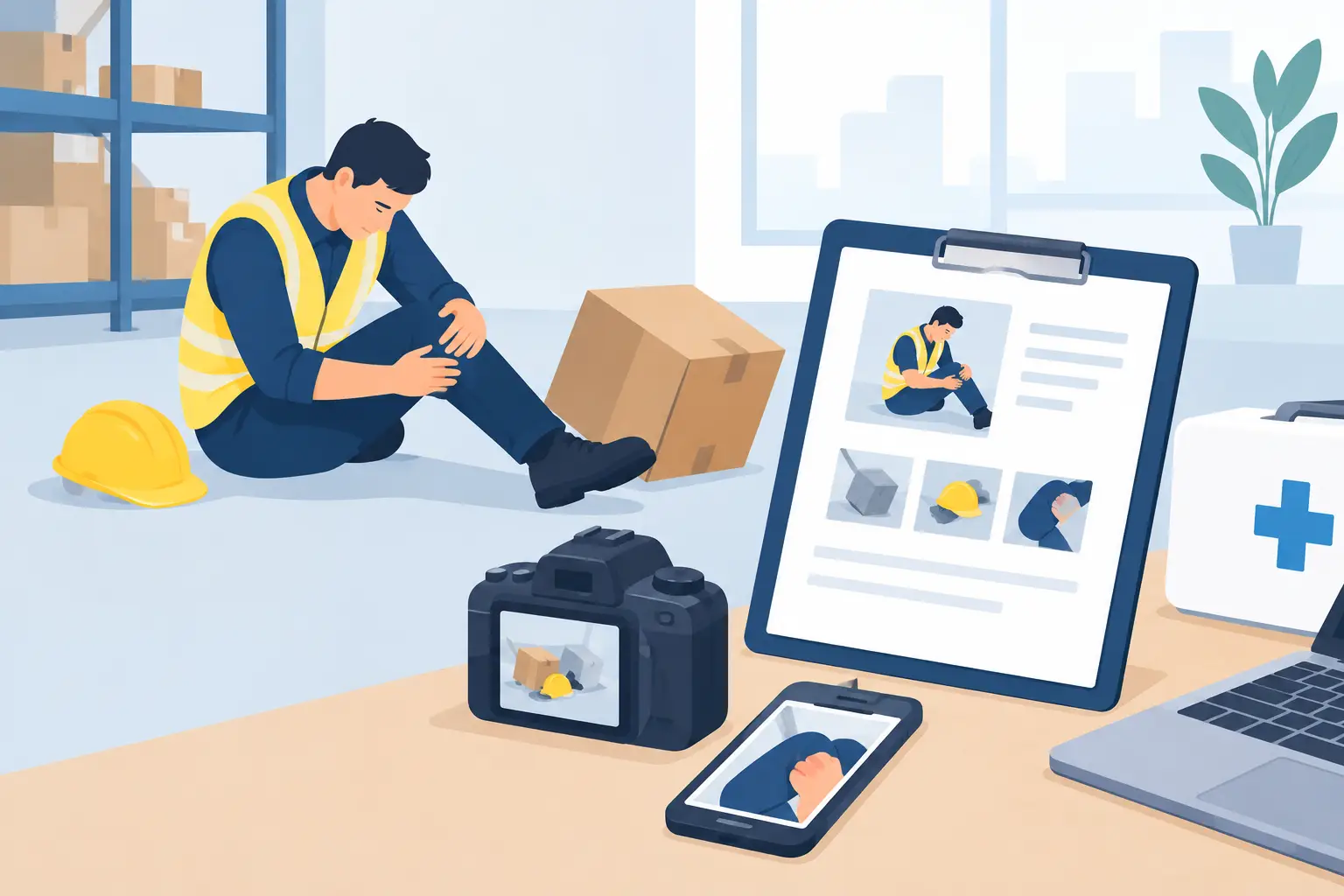
Photographs and video can capture details that disappear quickly. If you can do so safely, take wide shots of the entire area and close-up images of the hazard, damaged equipment, warning signs, lighting, footwear, safety gear, and visible injuries. Ask a trusted coworker or family member to help if pain or medical treatment makes that impossible.
For serious construction accidents, the physical scene may reveal whether required protections were missing. A photo of an unsecured ladder, an open floor edge, a defective scaffold plank, a missing guardrail, or debris in a walkway can be far more powerful than a recollection months later.
Do not alter, repair, clean, or throw away any item connected to the incident if it can be preserved. That includes helmets, harnesses, tools, clothing, boots, machinery components, and personal items damaged in the accident. Keep them in the condition they were in after the event. If an employer or contractor controls the equipment, a lawyer can act quickly to demand that key materials, records, and footage be preserved.
Identify the People Who Saw What Happened
Coworkers may be reluctant to get involved, especially when a supervisor is nearby or everyone fears losing work. Still, witnesses can provide critical information about unsafe practices, prior complaints, rushed schedules, missing safety equipment, and what occurred immediately before and after the accident.
Get names, phone numbers, job titles, and employer information for anyone who saw the incident or arrived moments afterward. Also identify workers who know the history of the hazard. A person who did not see the fall may still know that a stairway had been wet for days or that a machine had malfunctioned repeatedly.
Your own account matters too. As soon as you are physically able, write down what you remember. Include the date, time, location, weather, task, equipment involved, instructions you received, people present, and words spoken by supervisors or coworkers. Memory fades, particularly when someone is dealing with surgery, medication, pain, and financial stress.
Evidence Beyond Photos: Records That Can Prove Fault
The strongest case is rarely built on one photograph or one witness. It is built by connecting the scene, the medical proof, the safety records, and the responsible party’s actions.
Important records can include:
- Incident reports, daily logs, timesheets, and jobsite safety meeting records
- Surveillance video, dash camera footage, and phone photos or messages
- Equipment inspection, maintenance, repair, and purchase records
- OSHA-related documents, prior complaints, permits, and training materials
- Contracts identifying the owner, general contractor, subcontractors, and site responsibilities
- Medical records, diagnostic imaging, work restrictions, and wage documentation
Not every item will apply to every claim. A fall at a retail job, a factory amputation, a truck crash during a delivery route, and a scaffold collapse require different proof. The common thread is urgency. Video may be overwritten. A contractor may remove the defective equipment. A witness may move away. The longer you wait, the easier it becomes for the other side to argue that the facts cannot be confirmed.
Be Careful With Insurance Calls and Social Media
After an injury, an insurance representative may sound concerned and ask for a recorded statement. Their job is to protect the insurer’s financial interests, not to build your claim. A rushed statement can be used to create confusion about fault, your symptoms, or whether you were following instructions.
You do not need to speculate about what happened, minimize pain, or agree that you are fully recovered. If you do provide information, stick to known facts. Do not sign broad medical releases or settlement documents without understanding what rights you may be giving up.
Social media can also be taken out of context. A photo from a family gathering does not show the pain, medication, or recovery effort behind it, but an insurer may try to use it that way. Consider pausing public posts about the accident, your health, physical activities, and the legal claim. Ask friends and family not to post images or comments that could be misinterpreted.
Construction Workers May Have Additional Protections
New York construction injury claims can involve powerful legal protections, especially when a worker falls from a height or is struck by a falling object. The facts still matter. The height, the equipment used, the work being performed, the safety devices provided, and the parties controlling the site can all affect the claim.
New Jersey cases likewise depend on who controlled the work, what hazards were known, and whether safety rules were followed. A worker may have a valid claim even if a direct employer is protected by workers’ compensation rules, because another company or property owner may bear responsibility.
These cases frequently require fast investigation and significant resources. Engineers, safety professionals, medical specialists, accident reconstruction experts, and vocational experts may be needed to show both liability and the true cost of a permanent injury.
Get Help Before Critical Proof Disappears
You do not need to determine every legal issue while you are in pain. You do need to protect yourself from avoidable mistakes. Keep copies of everything you receive, follow medical instructions, document missed work and expenses, and avoid assuming that workers’ compensation is your only option.
The Cakani Law Firm, P.C. represents seriously injured workers and families throughout New York and New Jersey in complex workplace and construction injury cases. We investigate difficult claims, pursue the evidence, and take on the companies and insurers that may expect an injured worker to give up. There are no attorney fees unless we recover compensation for you.
The proof that explains your accident may be gone tomorrow. Getting clear advice early can help preserve the facts while you focus on the far more urgent work of healing and moving forward.

