
By The Cakani Law Firm, P.C.
How we won Labor Law § 240(1) liability for a roofer who fell 20 feet in Brooklyn, even though the defense said he unhooked his harness.
Attorney Advertising. Prior results do not guarantee a similar outcome.
The Accident
In December 2022, our client, a roofer, was working on a renovation at a community center on Coney Island Avenue in Brooklyn. The project was paid for with post–Superstorm Sandy rebuilding funds and run by the Dormitory Authority of the State of New York (DASNY), which hired the roofing contractor.
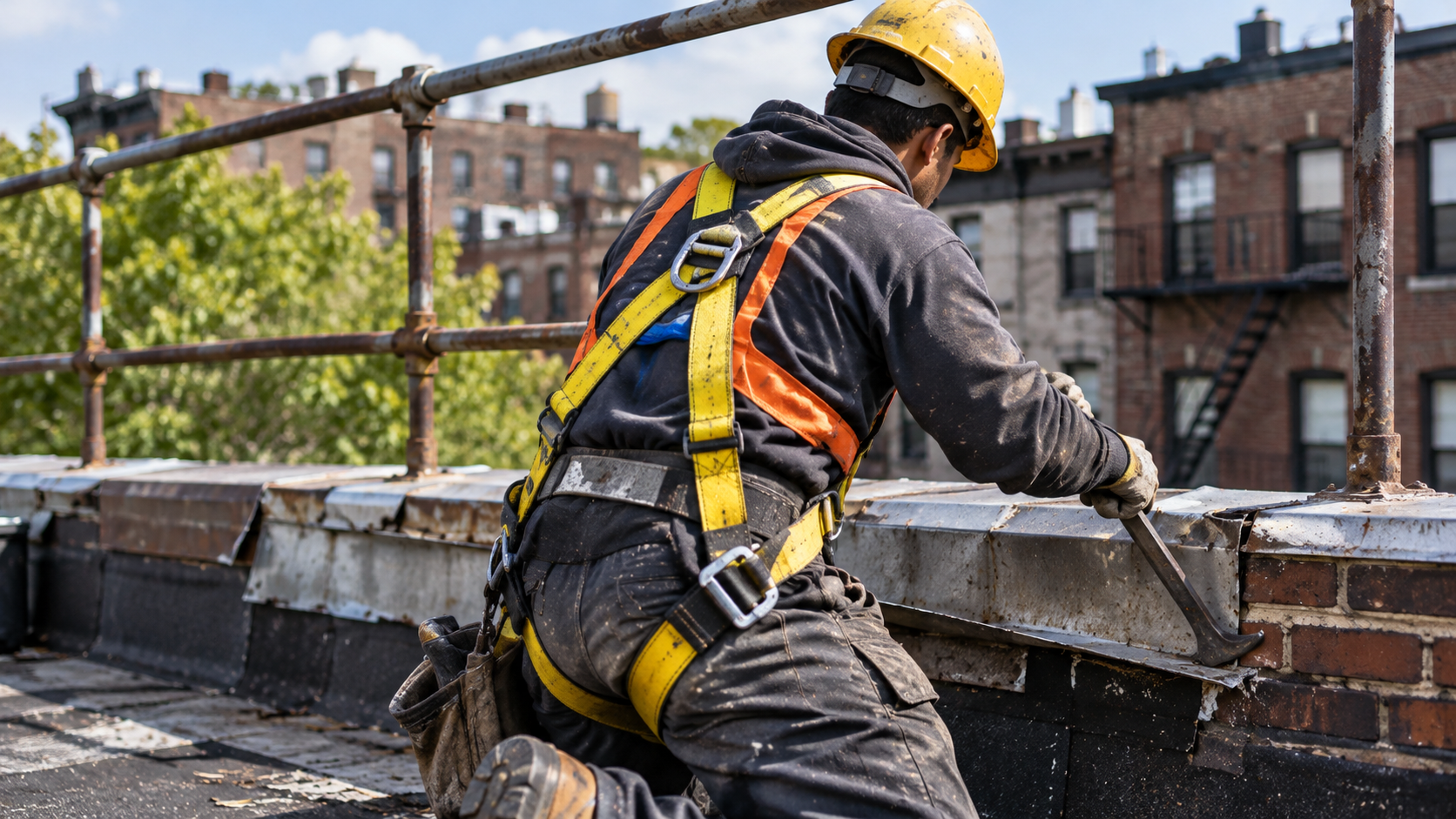
His job that day was to tear old metal flashing off the edge of the roof. To reach it, he had to stand partly outside the roof’s perimeter railing and lean over the edge. He held a crowbar in one hand and held the railing with the other for balance. As he pried at the flashing, the middle bar of the railing broke loose.
With nothing left to hold, he fell about 20 feet to the parking area below and was seriously hurt.
The Defense: “He Had a Harness”
The defendants built their defense around one fact: the employer gave our client a safety harness. The contractor’s site safety supervisor said in a sworn affidavit that our client had been tied off and disconnected his harness before he fell. In other words, it was the worker’s fault.
Our client testified otherwise. He wore the harness all day, but where he was working there was no safety line to clip into. The only line he saw was already being used by a coworker.
In many kinds of injury cases, a dispute like that could undermine the claim. Under New York’s Scaffold Law, however, comparative negligence does not defeat an otherwise valid claim.
Why the Harness Didn’t Save the Defendants
New York Labor Law § 240(1) puts a nondelegable duty on property owners and general contractors. They must provide safety devices that actually protect workers from gravity-related hazards like falls from height. If they don’t, and that failure is a cause of the injury, they may be held liable.
Just as important, a worker’s comparative negligence is not a defense under § 240(1). In its decision, the Kings County Supreme Court held that any question about whether our client had a proper tie-off point or unhooked his harness was “not determinative.” At most, it was evidence of comparative fault, which does not reduce liability under the statute.
The court granted summary judgment on liability under Labor Law § 240(1) against the property owner. That means the owner was held legally responsible for the fall without a trial on fault.
The Real Failure: The Wrong Safety Device
The court’s ruling turned on a simple point: the job should never have required a worker to hang over the edge of a roof in the first place.
- The defendants’ own Site Safety Plan called for articulating boom lifts during the roofing phase. A boom lift would have let our client stand on a stable platform and work on the flashing at eye level, from outside the building.
- The contractor’s own safety supervisor admitted at his deposition that the work would have been safer from a man lift or a scaffold than by having workers lean over the roof edge.
- Our construction-safety expert confirmed that standard practice is to do edge work from scaffolding or aerial lifts, and that the lifts were readily available to rent in New York City.
The court found that our client proved his case because he had to lean over the side of the building to do the work instead of working from a lift. A harness doesn’t fix a work method that is unsafe from the start.
A Harness Is Only as Good as What It’s Tied To
We also showed that the fall-arrest system itself fell short. New York courts have long held that giving a worker a harness is not enough. There must also be a proper anchorage point and a proper safety line (Miglionico v. Bovis Lend Lease; Vetrano v. J. Kokolakis Contracting; Cordeiro v. TS Midtown Holdings).
The evidence here showed:
- The anchors were never tested or certified. The “anchors” were concrete posts on the roof, and they were “tested” by having workers pull on the rope.
- The lifeline was wrapped around short, tapered posts. The posts were only 2–3 feet high and narrower at the top, so a line could slide up and off during a fall.
- There was too much slack in the rope. This allowed a dangerous fall distance, and nothing protected it from the sharp edges of the roof or the metal flashing being removed.
- One safety line was shared by several workers doing edge work. Four coworkers gave sworn statements that no one told them where to tie off.
- Fall protection was not properly monitored. DASNY’s project manager visited the site regularly. He testified he never saw fall protection used on that roof and didn’t know whether any anchorage points existed, even though he had authority to stop unsafe work.
When the anchorage is improvised, untested and unsafe, the question of whether a worker was clipped in doesn’t matter much. The protection was never adequate.
Who Is Responsible?
The property owner. The owner did not hire the roofing contractor and was not running the job. Under § 240(1), an owner’s duty can’t be handed off to someone else. The court held the owner liable.
What This Means for Injured Construction Workers
If you were hurt in a fall on a New York construction site, don’t assume you have no case because:
- You weren’t tied off when you fell.
- The employer gave you a harness.
- The insurance company says it was your fault.
- The property owner says they had nothing to do with the work.
The real questions are whether the right safety device was provided for the job, and whether it actually protected you. Often the answer is in the project’s own safety plan, the anchorage setup and the testimony of the people who ran the site.
Talk to The Cakani Law Firm
The Cakani Law Firm, P.C. represents injured construction workers and their families in Labor Law, scaffold and fall-from-height cases across New York and New Jersey.
We have offices in White Plains, Manhattan and Englewood Cliffs, NJ.
Contact us today for a free consultation. You pay nothing unless we win.
Phone: (212) 962-0500
Email: pcakani@cakanilaw.com
Website: www.cakanilaw.com
Attorney Advertising. This post is for general information only and is not legal advice. Prior results do not guarantee a similar outcome.

