
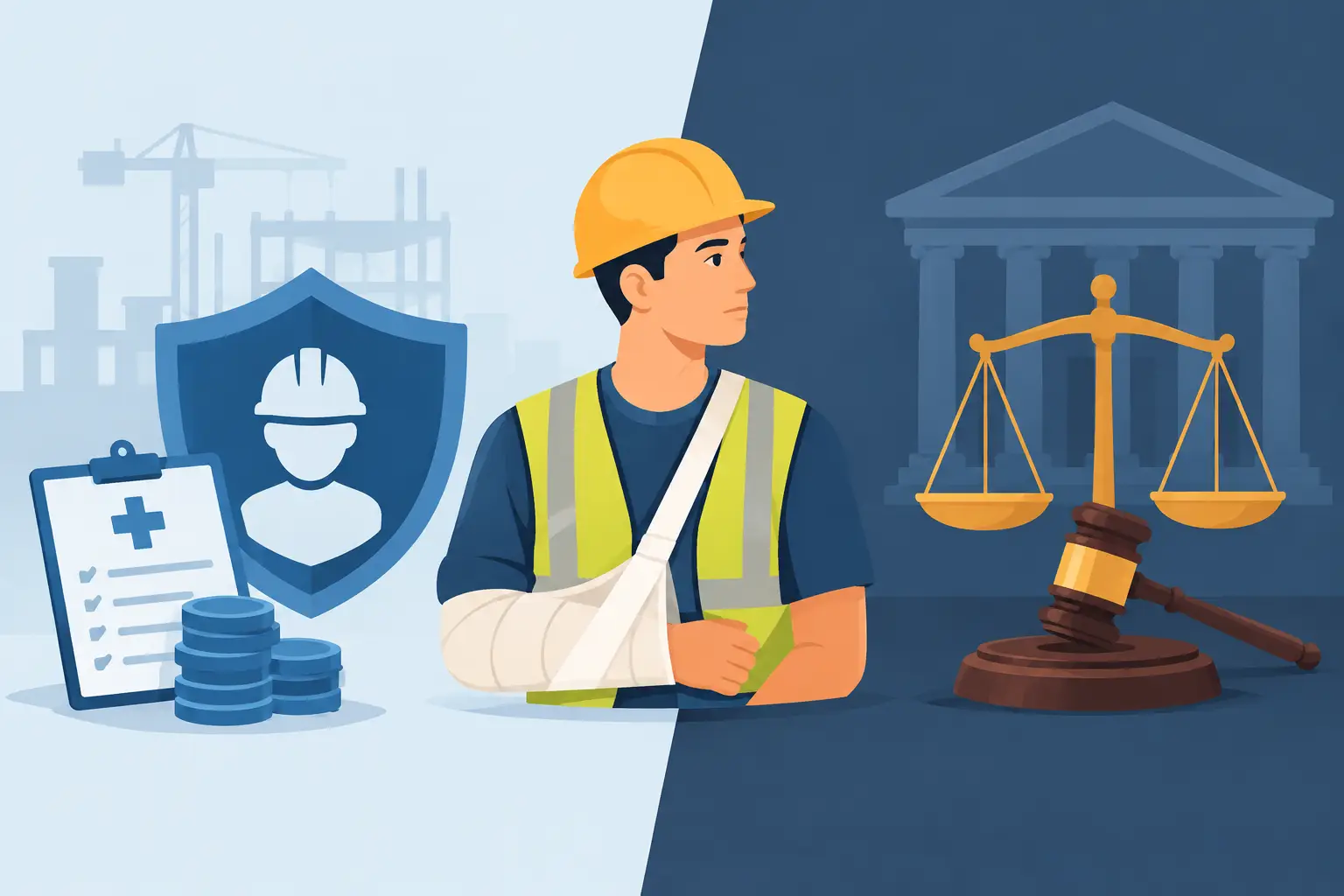
A serious workplace injury can put a family under pressure within hours. Medical bills arrive, wages stop, and an insurance representative may start asking for information before you know the full extent of your injuries. When people ask about workers compensation versus injury lawsuit options, they are usually asking one urgent question: What can I do to protect my financial future?
The answer depends on how the accident happened and who may be legally responsible. Workers’ compensation benefits can provide a vital source of immediate help, but they do not always cover the full cost of a life-changing injury. In many New York and New Jersey workplace cases, an injured worker may have both a workers’ compensation claim and a separate personal injury claim against a negligent third party.
Workers Compensation Versus Injury Lawsuit: The Core Difference
Workers’ compensation is generally an insurance system for employees hurt while performing their jobs. It is designed to provide benefits without requiring the injured worker to prove that an employer was careless. In exchange, employees usually cannot bring a standard negligence lawsuit against their own employer.
A personal injury lawsuit is different. It is a civil claim against a person, business, property owner, contractor, driver, equipment manufacturer, or another party whose negligence caused the injury. Unlike workers’ compensation, a lawsuit requires proof that another party had a legal duty, failed to meet it, and caused harm as a result.
That distinction can have an enormous impact on recovery. Workers’ compensation may address medical care and a portion of lost wages. A successful injury lawsuit can seek the broader damages that workers’ compensation generally does not pay, including the human cost of the injury.
What Workers’ Compensation May Cover
Workers’ compensation is often the first claim an injured employee should report after a workplace accident. The rules, reporting deadlines, medical treatment requirements, and benefit calculations vary between New York and New Jersey, so prompt action matters.
Depending on the circumstances, workers’ compensation benefits may include medical treatment, partial wage replacement while you are unable to work, and disability benefits for a lasting impairment. Families may also have access to death benefits after a fatal work accident.
The system has a major advantage: fault is not usually the central issue. A worker may qualify even if no one intended harm and even if the worker made a mistake that contributed to the accident. But the trade-off is significant. Wage benefits are limited, and workers’ compensation does not typically compensate an injured person for pain and suffering, loss of enjoyment of life, or the full economic damage a catastrophic injury can create.
For a construction worker with a traumatic brain injury, spinal injury, amputation, severe burn, or multiple fractures, those limits can leave a serious gap between benefits and the actual cost of the harm.
When a Workplace Injury Can Become a Lawsuit
An injury lawsuit may be possible when someone other than the employer caused or contributed to the accident. These are often called third-party claims. The responsible party could be a general contractor, subcontractor, property owner, site manager, delivery company, negligent driver, equipment manufacturer, or outside maintenance company.
Consider a few common situations. A delivery driver is hit by a commercial truck while making a work delivery. A laborer falls from an unsecured scaffold at a job site controlled by another company. A warehouse employee is badly injured by a defective machine made by an outside manufacturer. A nurse is struck by a vehicle while traveling between work locations.
In each scenario, workers’ compensation may be available because the injury happened in the course of employment. But a separate lawsuit may also exist because another party had a role in causing the accident.
New York construction cases require especially close review. State labor laws may provide powerful protections for workers injured in elevation-related accidents involving scaffolds, ladders, falling objects, and other gravity-related hazards. Property owners and contractors may face liability even when they did not directly employ the worker. These claims are fact-specific, and the companies involved often move quickly to protect themselves after a serious accident.
What an Injury Lawsuit Can Seek
A third-party personal injury case is not a replacement for workers’ compensation. It can be an additional path to accountability and fuller financial recovery. Where the evidence supports a claim, damages may include:
- Past and future medical expenses not fully addressed by available benefits
- Full lost earnings and diminished future earning capacity
- Physical pain, emotional suffering, and loss of enjoyment of life
- Financial losses suffered by a spouse or family after a catastrophic or fatal injury
The value of a case depends on the severity of the injury, available insurance coverage, the defendants involved, the strength of the evidence, and many other facts. No responsible lawyer should promise a particular outcome. Still, when a worker has been permanently harmed, identifying every potential source of recovery can be essential.
Why You Should Not Assume Workers’ Compensation Is Your Only Option
Employers and insurance carriers may frame a work injury as a straightforward workers’ compensation matter. That does not mean a third-party case has been ruled out. It may simply mean no one has yet performed the investigation needed to identify all responsible parties.
At a construction site, responsibility can be spread across multiple companies with separate contracts, safety duties, and insurance policies. Surveillance footage may be overwritten. A damaged ladder, saw, harness, or piece of equipment may disappear. Witnesses may become difficult to locate. The incident report may be incomplete or written to minimize what happened.
A serious injury claim needs more than a quick review of paperwork. It may require photographs, site records, employment documents, video, witness interviews, safety policies, medical evidence, and opinions from engineering, construction safety, accident reconstruction, or medical experts. The earlier this work begins, the better the chance to preserve critical proof.
There are also deadlines. Workers’ compensation claims have notice and filing requirements. Personal injury lawsuits are subject to statutes of limitations, and claims involving public entities may have much shorter notice periods. Waiting until you feel physically stronger can be risky if evidence or legal rights are lost in the meantime.
Can You Receive Both Types of Compensation?
Often, yes. An injured worker can pursue workers’ compensation benefits while bringing a third-party lawsuit against a negligent non-employer. However, the interaction between the two claims is complicated.
The workers’ compensation carrier may claim a lien or seek reimbursement from part of a third-party recovery for benefits it paid. The details matter. A lawyer should evaluate the lien, the settlement structure, future medical needs, and the effect of any recovery on the injured worker and family. Accepting a quick settlement without understanding those issues can create avoidable financial problems.
There are limited exceptions in which an employer may face direct legal exposure, but those exceptions are narrow and depend heavily on state law and the facts. The more common route is a third-party action against the companies or individuals outside the employment relationship who created the dangerous condition.
What to Do After a Serious Work Accident
Your health comes first. Get medical care, follow treatment recommendations, and tell your providers that the injury occurred at work. Report the accident to your employer as soon as possible, even if you believe a supervisor already knows about it.
If you are able, preserve what you can: photographs of the location and injuries, contact information for witnesses, names of companies on site, messages about the job, and copies of medical and incident reports. Do not give a recorded statement or sign broad paperwork for an insurer before you understand what it means. Insurers are not responsible for protecting your claim.
The Cakani Law Firm, P.C. evaluates serious workplace and construction injuries throughout New York and New Jersey, including cases other firms may lack the resources to pursue. A legal review can identify whether the facts support workers’ compensation benefits, a third-party injury lawsuit, or both. There are no attorney fees unless we win.
You do not need to know every law before asking for help. You need to act before powerful companies, insurers, and deadlines narrow your options. A prompt case evaluation can give you a clearer path forward while you focus on healing and supporting the people who depend on you.

