
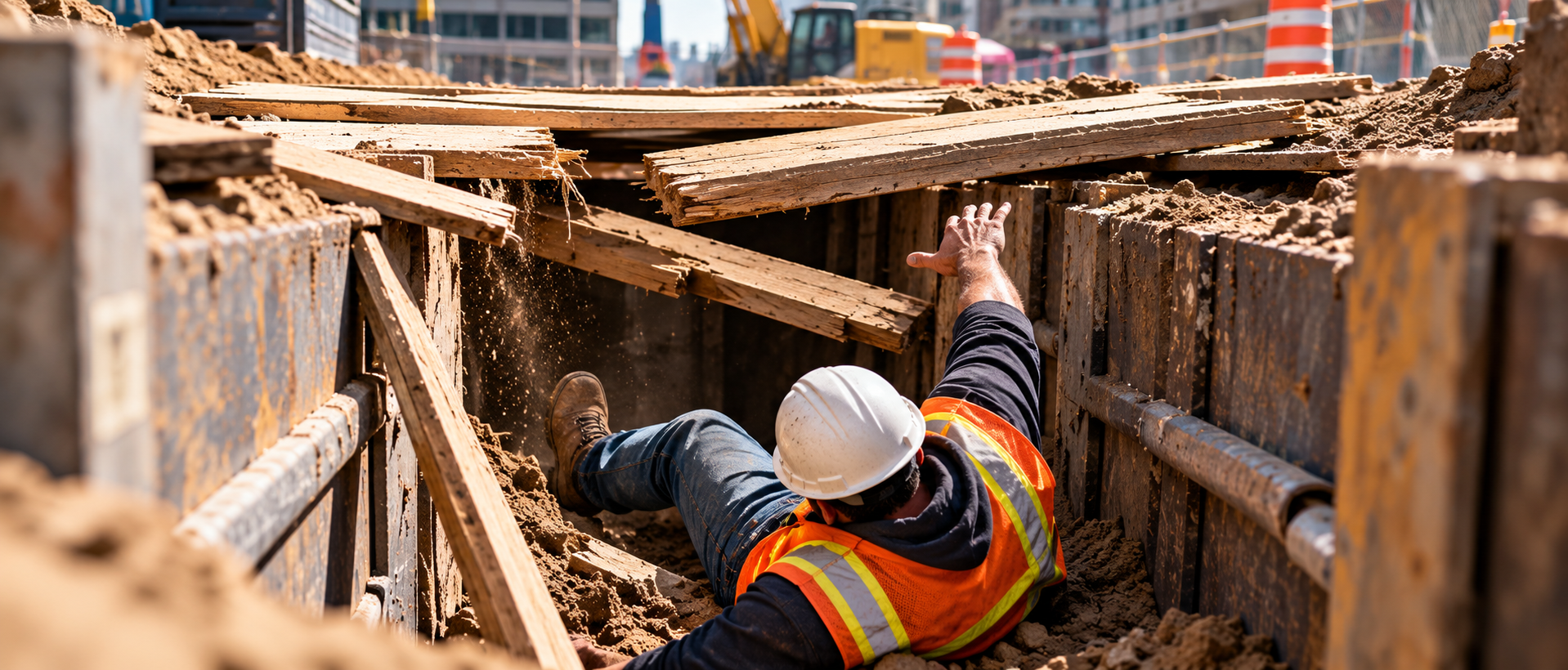
The Cakani Law Firm recovered a $3,000,000 settlement for a veteran water and sewer worker who fell more than seven feet into an open trench when a makeshift wooden cover gave way beneath him on a Bronx construction site.
The case settled in December 2025, after our firm won summary judgment on liability under New York Labor Law § 240(1) — the “Scaffold Law” — and Labor Law § 241(6). With liability decided, the only question left was how much our client’s injuries were worth.
What Happened
In October 2018, our client was installing new water and sewer lines for a residential building under construction in the Bronx. He had done this work for about 20 years.
His crew dug a trench roughly 7½ feet deep and 3 feet wide to reach the connection points. At the end of the day, they covered it with loose lumber: two boards laid across the opening, with four planks on top. The lower boards could not be nailed down because there was nothing solid to fix them to. No steel plate was provided for that trench, even though steel plates were used for openings in the sidewalk and street.
The following Monday, our client had to cross that cover to retrieve shoring lumber. It was the only route available. As he stepped onto it, a 2×4 snapped and the cover collapsed. He fell to the bottom of the trench, and the heavy planks fell in on top of him, striking his shoulder. He later learned that someone had removed one of the supporting boards over the weekend. He had no harness or fall protection.
His Injuries
The fall caused serious injuries to his shoulder, neck, and lower back. Over the next four years he underwent five surgeries:
- Shoulder arthroscopy to repair labral and rotator cuff tears (2019)
- Lumbar laminectomy at L4–L5 (2019)
- Cervical discectomy and fusion at C5–C6 (2020)
- Revision lumbar laminectomy at L5–S1 (2020)
- Lumbar fusion from L4 to S1 with rods, screws, and an interbody cage (2022)
He also needed repeated spinal injections. He has not been able to return to work since the accident.
The Legal Fight
We filed suit in Bronx County Supreme Court in January 2019 against the property owner, the general contractor listed on the building permits, the plumbing contractor that hired our client’s employer, the City of New York, and others.
Every defendant pointed at someone else:
- The owner argued it had no role in how the trench was covered.
- The plumbing contractor claimed it had left the site before the accident and never supervised the work.
- The general contractor said its name was on the permits but it controlled nothing.
- The City argued the trench was on private property, not city land.
- Everyone argued that our client caused his own accident because his crew built the cover.
After four days of our client’s deposition and depositions of every company involved, we moved for summary judgment on liability in November 2023.
How We Won
In September 2024, the court granted our motion and held the property owner and the plumbing contractor liable under Labor Law § 240(1) and under Labor Law § 241(6), based on a violation of Industrial Code 12 NYCRR § 23-1.7(b), which requires hazardous openings to be covered or guarded.
Four things made the difference.
1. We framed the collapse as a safety-device failure.
Labor Law § 240(1) makes owners and contractors absolutely liable when a worker is hurt by a gravity-related hazard because proper protection was not provided. A trench cover that breaks under a worker’s weight is a safety device that failed. The court agreed that the lack of an adequate, secured cover was a proximate cause of the fall.
2. We backed it with engineering proof.
Our licensed professional engineer explained that loose, unsecured lumber was never an adequate cover for a 7½-foot trench. A steel plate or other substantial cover should have been used, and would have prevented the accident. He also explained that the snapped 2×4 was itself proof the protection failed.
3. We defeated the “he did it to himself” defense.
Defendants argued our client’s own crew built the cover. Under the Court of Appeals’ decision in Blake v. Neighborhood Housing Services of N.Y. City (1 N.Y.3d 280 [2003]), a worker cannot be the sole proximate cause of his accident when a statutory violation contributed to it. The court held that any carelessness in how the trench was covered was, at most, comparative negligence — which is no defense to a § 240(1) claim.
4. We kept the case focused on who could pay.
The court also held that the plumbing contractor was entitled to contractual indemnification from our client’s employer. That ruling brought the employer’s insurance coverage to the table.
With liability established, we took the case to mediation, backed by five surgeries, permanent loss of earning capacity, and verdict research on comparable New York spinal-fusion cases. The case resolved for $3,000,000 in December 2025.
What This Means If You Were Hurt on a Construction Site
- You may have a case even if you set up the equipment yourself. New York’s Labor Law puts the safety duty on owners and contractors, not on the worker.
- Workers’ compensation is not your only option. You generally cannot sue your own employer, but you can sue the property owner and other contractors on the job.
- Falls into trenches, holes, and openings are covered. An inadequate cover over an opening can violate both § 240(1) and § 241(6).
- Evidence disappears fast. Photos, witness names, and the condition of the equipment matter. Call a lawyer early.
Talk to The Cakani Law Firm
If you or a family member was injured on a New York construction site, contact The Cakani Law Firm for a free consultation. We have offices in White Plains, Manhattan, and Englewood Cliffs, NJ. Call (212) 962-0500.
Attorney Advertising. Prior results do not guarantee a similar outcome. Client identity and identifying details have been withheld to protect the client’s privacy.

