
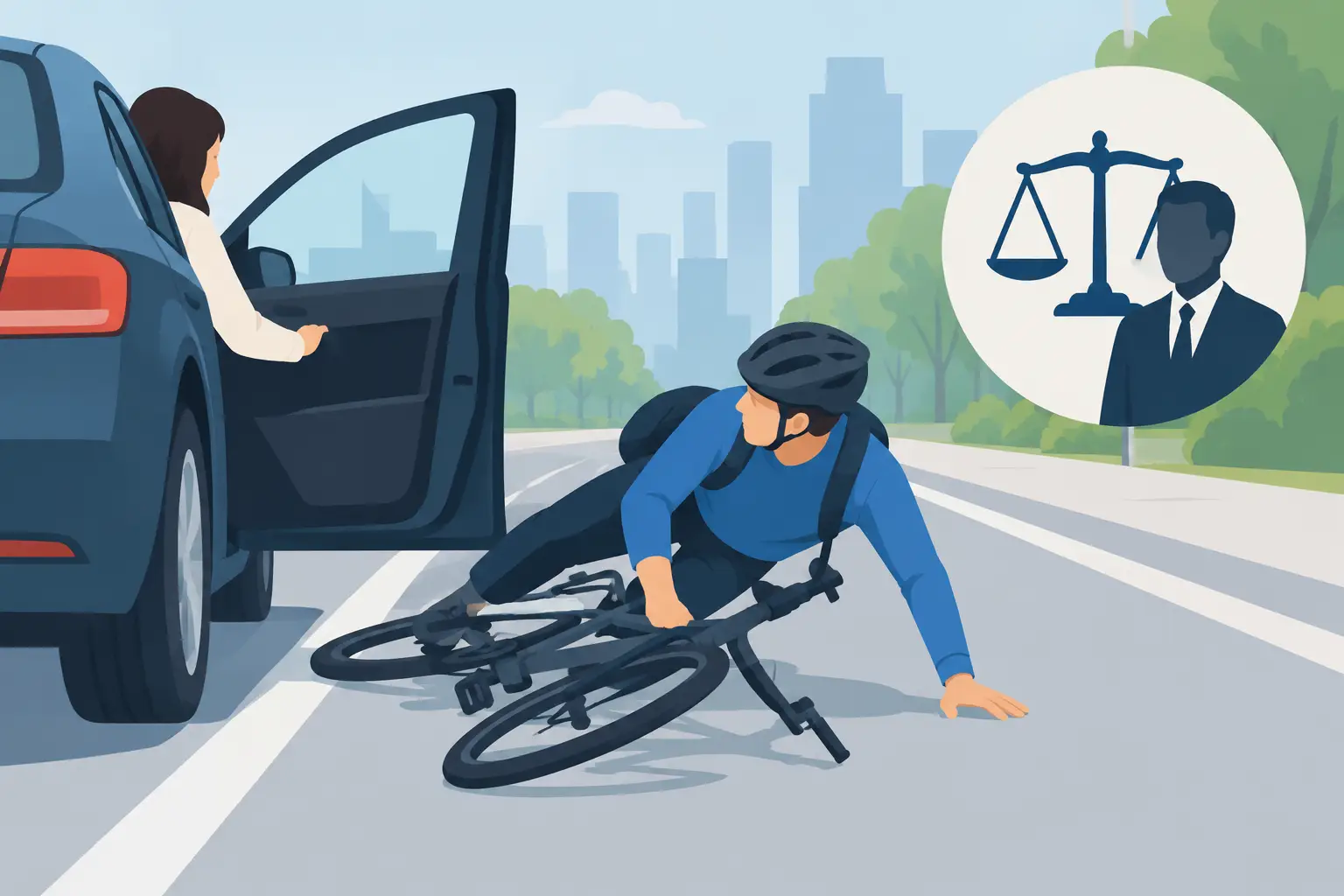
A bicycle dooring accident lawyer can help when a driver or passenger suddenly opens a vehicle door into your path, leaving you no time or room to avoid impact. These crashes are often dismissed as minor by the person who opened the door. But a cyclist can be thrown into traffic, onto pavement, or into another fixed object in seconds, with injuries that disrupt work, family life, and financial security.
Dooring collisions are not simply unavoidable city hazards. In many cases, the person opening the door had a duty to check for approaching cyclists before stepping into the bike lane or roadway. Proving what happened, however, takes prompt action. Evidence can disappear quickly, and insurance companies often look for a reason to blame the rider.
Why bicycle dooring crashes cause serious harm
A car door is an unyielding barrier. When it opens into the path of a moving bicycle, the rider may strike the door directly, flip over it, or swerve into a moving vehicle. Even a crash at what seems like a modest speed can cause a concussion, broken collarbone, wrist fracture, facial injuries, spinal damage, road rash, or knee and shoulder injuries that require surgery.
The physical injury is only part of the loss. Many injured cyclists cannot return to their jobs, care for children, commute, or perform the ordinary tasks that once required no thought. Treatment may include emergency care, imaging, surgery, physical therapy, pain management, and time away from work. A claim should account for the full effect of the collision, not just the first medical bill.
New York City streets create particular risks because cyclists often travel beside parked cars, delivery vehicles, taxis, rideshare vehicles, and buses. A driver who stops in a bike lane or a passenger who exits without looking can create the same dangerous condition. The details matter because they can determine who is legally responsible and what insurance coverage may be available.
What a bicycle dooring accident lawyer investigates
The central question is usually straightforward: did the person opening the door fail to use reasonable care before opening it into the cyclist’s path? The proof is often more complicated. The driver may claim the cyclist was speeding, riding too close to parked cars, or came from nowhere. Those claims should be tested against evidence, not accepted at face value.
A bicycle dooring accident lawyer investigates the scene, the vehicle, the people involved, and the available insurance policies. Depending on the circumstances, a claim may involve the driver, the passenger who opened the door, the vehicle owner, a rideshare company, a commercial business, or another party. If unsafe roadway design, construction activity, or a hazardous obstruction contributed to the crash, additional investigation may be necessary.
Strong cases are built before the evidence is gone. That may include:
- Photos of the vehicle, open door, bike lane, traffic markings, and damage to the bicycle
- Video from nearby businesses, residences, dash cameras, traffic cameras, or vehicle systems
- Statements from people who saw the door open or witnessed the rider’s path before impact
- Police reports, 911 recordings, dispatch information, and records identifying the driver or vehicle owner
- Medical records that connect the crash to the injury and document the treatment still ahead
- Expert analysis from accident reconstruction, medical, bicycle safety, or vocational professionals when the injuries are severe
A police report can be useful, but it is not the final word. Officers may arrive after the collision, hear conflicting accounts, or omit details that later prove important. The same is true of an insurer’s initial assessment. A serious injury claim deserves an independent investigation.
Do not let an insurer turn the crash into your fault
Insurance companies frequently focus on cyclist behavior. They may ask whether you wore a helmet, used lights, rode outside a marked bike lane, or could have stopped sooner. Some questions may be relevant, but they do not erase the duty of a person opening a vehicle door to look for cyclists and other approaching traffic.
New York and New Jersey both allow injury claims where more than one person may have contributed to an accident, though the rules and effect of comparative fault differ. An insurer may use any alleged fault to reduce or challenge payment. That is why an injured rider should avoid guessing about speed, distance, or fault in a recorded statement before speaking with counsel.
The condition of the bicycle can also become an unfair distraction. A bent wheel, broken helmet, damaged clothing, and bike computer may help show the force and direction of impact. Do not repair, discard, or give away those items until they have been photographed and evaluated. Preserve the bicycle in the condition it was in after the crash whenever possible.
Steps to take after a dooring crash
Your health comes first. Get emergency treatment when needed, and follow up with a doctor even if pain seems manageable at the scene. Adrenaline can mask symptoms, and head, neck, joint, and soft-tissue injuries may become clearer over the following days.
If you are able, obtain the driver’s name, contact information, license plate number, insurance information, and photographs of the vehicle. Ask witnesses for their names and phone numbers. Take pictures of the open door, the roadway, signage, lane markings, and your injuries. If you cannot do these things because you are hurt, ask a bystander or family member to help as soon as possible.
Report the collision to the police and seek medical care. Then keep every record connected to the event, including bills, discharge instructions, receipts, work absence information, communications from insurers, and a simple daily record of pain and activity limits. This is not busywork. It helps show the real consequences of an injury that may not be obvious in a single emergency-room visit.
You should also be cautious with social media. A photo of you standing at a family event or briefly outside can be taken out of context and used to question the severity of your injuries. Focus on recovery rather than defending your life online.
Compensation should reflect the full loss
A dooring claim may seek compensation for past and future medical expenses, lost income, reduced earning capacity, physical pain, emotional distress, and the damage to your bicycle and other property. When a cyclist suffers a permanent injury, scarring, disability, or loss of normal function, the future impact may be substantial.
The available recovery depends on the facts, insurance coverage, the seriousness of the injuries, and the parties involved. A taxi, delivery vehicle, company-owned car, or rideshare trip can raise coverage and responsibility issues that require careful review. If a loved one died in a bicycle dooring collision, surviving family members may have the right to pursue a wrongful death claim, subject to state-specific rules and deadlines.
Time matters. Surveillance footage can be overwritten in days, witnesses can become hard to locate, and legal deadlines can limit a claim. Claims involving public entities may have especially short notice requirements. Waiting for an insurer to “see how things go” can put critical evidence at risk.
Serious bicycle injury cases require real resources
A dooring collision may look simple from a distance, but insurers defend these cases aggressively when the injuries are significant. They may dispute how the crash occurred, argue that treatment was unnecessary, or minimize the effect of an injury on a person’s ability to work and live normally.
The Cakani Law Firm, P.C. represents injured people and families in New York and New Jersey with the focused litigation strength difficult cases demand. The firm has recovered more than $300 million for clients and pursues claims with the resources to investigate liability, work with qualified experts, and confront insurers that refuse to treat people fairly. There are no attorney fees unless we win.
If a car door changed the course of your day, your career, or your family’s future, you do not need to decide the value of your case while you are in pain. Preserve what you can, get the medical care you need, and seek a prompt legal evaluation before the proof of what happened disappears.

