
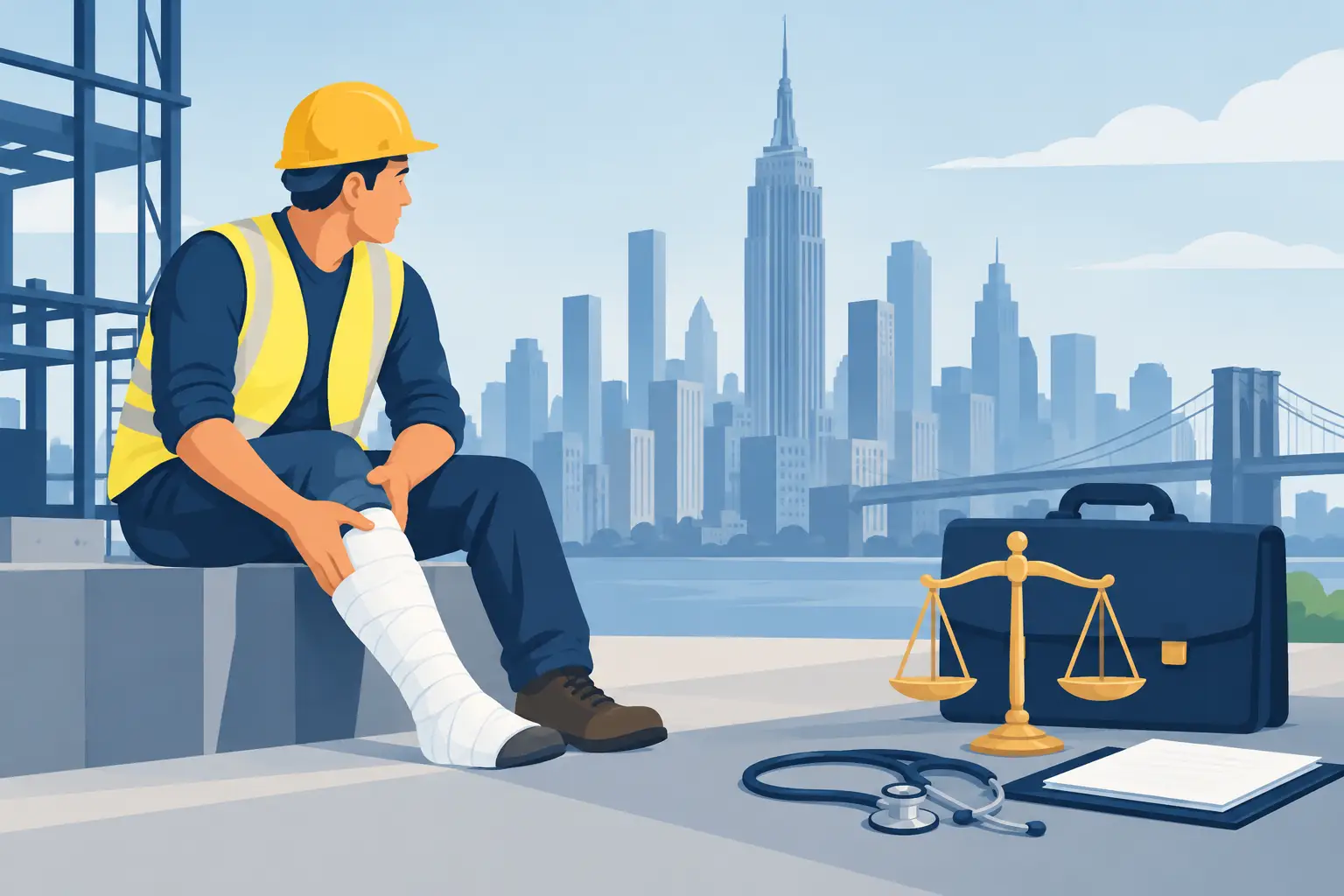
A fall from a scaffold, a collapsing ladder, or a load dropped from above can change a worker’s life in seconds. The medical bills and missed pay start immediately, while insurance carriers and employers may push for a quick, limited resolution. This New York labor law guide explains the protections that may apply after a serious construction injury and why a workers’ compensation claim is not always the end of the story.
New York Labor Law is often discussed as if it were one rule. It is not. Several sections can create powerful rights for injured workers, especially when an owner, general contractor, subcontractor, or property manager failed to provide a safe jobsite. Whether a claim exists depends on the facts, the location, the work being performed, and the parties that controlled the project.
What This New York Labor Law Guide Covers
For injured construction workers, three provisions are frequently central to a personal injury lawsuit: Labor Law Sections 200, 240(1), and 241(6). They address different types of danger and impose different duties. A strong case begins by identifying which law fits the accident, then preserving evidence before a jobsite changes and witnesses disappear.
These laws generally concern construction, demolition, excavation, repair, alteration, painting, and related work. They do not automatically cover every workplace injury. An office worker hurt in a slip and fall, for example, may have a premises liability claim but not a Labor Law Section 240(1) claim. The details matter.
Section 240(1): Falls and Falling Objects
Labor Law Section 240(1), commonly called the Scaffold Law, protects workers from elevation-related risks. It may apply when a worker falls from a ladder, scaffold, roof, platform, hoist, or other elevated surface. It can also apply when an object falls because it was not properly secured or hoisted.
The law requires appropriate safety devices, not merely any device that happened to be on the site. A ladder that shifts, a scaffold without proper protection, or an unsecured load can expose owners and contractors to liability. In many cases, the property owner and general contractor have duties even if they did not personally direct the worker’s daily tasks.
Section 240(1) is a serious protection, but it is not a blank check. Defendants may argue that the worker had adequate safety equipment available, knew to use it, and chose not to do so for no good reason. They may also dispute whether the accident was truly caused by an elevation-related risk. Early investigation can make the difference between accepting an insurer’s version of events and proving what actually happened.
Section 241(6): Dangerous Construction Conditions
Labor Law Section 241(6) requires owners and contractors to provide reasonable and adequate protection and safety during construction, excavation, and demolition work. A claim under this provision usually depends on a violation of a specific New York Industrial Code safety rule.
That may involve unsafe passageways, missing guardrails, inadequate excavation protection, improper demolition procedures, hazardous floors, or failures involving power tools and machinery. The applicable rule must be concrete enough to impose a specific duty. A general allegation that a site was unsafe is usually not enough.
This is why serious construction cases require more than a quick review of an accident report. Lawyers may need to inspect the site, examine contracts, review safety plans and photographs, locate prior complaints, and work with construction safety experts. Powerful defendants often have records, investigators, and insurance companies working to limit their exposure. Injured workers deserve a legal team prepared to meet that effort head-on.
Section 200: Unsafe Worksites and Dangerous Methods
Labor Law Section 200 reflects an owner’s and contractor’s duty to maintain a reasonably safe workplace. It often applies in two different situations: dangerous premises conditions and unsafe means or methods of work.
For a dangerous condition claim, the key question may be whether the responsible party created the hazard or had notice of it. For an unsafe work-method claim, control is often crucial. Did the owner or general contractor direct the work, supervise the operation, or have authority to correct the unsafe practice? Those answers can determine who is legally responsible.
Section 200 claims may arise from debris-strewn work areas, defective flooring, exposed hazards, unsafe equipment practices, or other jobsite conditions. They can be valuable when an accident does not fit neatly into the elevation-related protections of Section 240(1).
Workers’ Compensation Is Not Always the Only Claim
Workers’ compensation can provide medical coverage and partial wage benefits after a job injury. But it generally does not compensate an injured worker for the full pain, suffering, loss of enjoyment of life, or future economic harm caused by a catastrophic injury. It also usually prevents a direct negligence lawsuit against the employer.
That does not mean no lawsuit is available. A worker may have a separate personal injury claim against a property owner, general contractor, subcontractor, equipment manufacturer, or another negligent third party. A delivery driver hit by another vehicle, a laborer injured by defective equipment, or a worker hurt on a site owned by a separate company may have claims beyond workers’ compensation.
The distinction is critical. Workers’ compensation and a third-party lawsuit can proceed at the same time, but they are different claims with different evidence, deadlines, and potential recovery. Never assume that filing for workers’ compensation means you have given up every other right.
What to Do After a Construction Injury
Your health comes first. Get medical care promptly and describe every injury and symptom, including head pain, dizziness, numbness, back pain, or emotional trauma. Gaps in treatment can be used by insurers to argue that an injury was not serious or was unrelated to the accident.
Report the incident as soon as possible and keep a copy of any report if you can. Take photographs of the scene, equipment, ladder, scaffold, debris, safety devices, and visible injuries. Save the names and contact information of coworkers who saw what happened. Do not rely on a supervisor to preserve evidence that could reveal a safety failure.
Be careful with recorded statements and broad medical authorizations requested by an insurance company. Their goal is often to reduce what they pay, not to determine what you need to rebuild your life. Before signing documents or accepting a settlement, understand the full scope of your injuries and your possible legal claims.
Deadlines Can Be Unforgiving
Many New York personal injury lawsuits have a three-year filing deadline, while wrongful death claims often have a two-year deadline. But exceptions can shorten the time dramatically. Claims involving a city, county, public authority, school district, or other government entity may require a notice of claim in as little as 90 days.
Workers’ compensation also has separate reporting and filing requirements. Waiting is risky because surveillance footage can be erased, equipment can be repaired or removed, and a construction site can look completely different within days. The right time to investigate is before the evidence is gone.
A Serious Injury Deserves a Serious Investigation
Insurance companies may treat a worker as a file number. The injured person knows the real cost: surgeries, missed birthdays, lost independence, chronic pain, and fear about supporting a family. The legal system cannot erase that harm, but a properly built claim can pursue the financial support needed for treatment, income loss, and the future.
At The Cakani Law Firm, P.C., we focus on high-stakes injury cases and invest in the experts, medical evidence, and investigation needed to confront powerful defendants. We do not charge attorney fees unless we win.
If a construction accident has left you or someone you love seriously injured, do not let an employer, contractor, or insurer decide what your case is worth before the facts are fully known. Protect the evidence, protect your options, and get clear answers while there is still time to act.

