
By Cakani Law Firm, P.C.
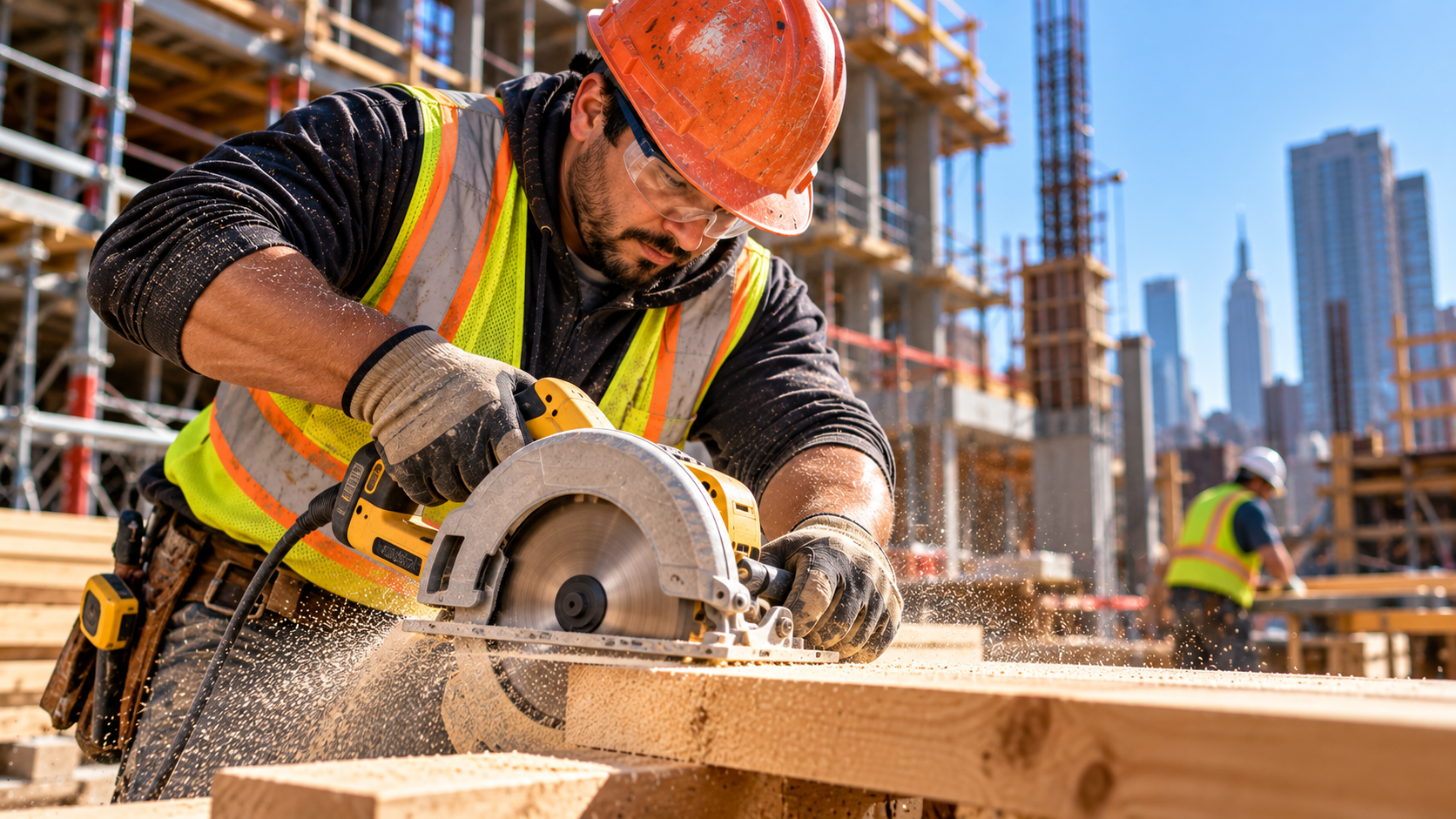
Power saws and grinders are on almost every construction site in New York. Framing crews cut lumber with circular saws, carpenters rip plywood on table saws, and laborers cut rebar, pipe and masonry with angle grinders and cut-off saws. These tools save time, but when a guard is missing, a blade binds, or a disc shatters, the results can change a worker’s life in a fraction of a second.
If you were cut by a saw or grinder while working construction in the Bronx, Yonkers, Westchester, Staten Island, or anywhere in New York, the law may give you more rights than you realize. New York has some of the strongest construction-worker protections in the country.
How Saw and Grinder Accidents Happen
Circular Saws (Hand-Held)
The most common cause is a missing, broken, or pinned-back lower blade guard. Workers are often told to tie or wedge the guard open to “work faster.” Kickback, when the blade binds in the material and the saw jumps back toward the operator, can drive the blade into the hand, thigh, or leg.
Table Saws
Hands slide into the blade when material shifts, breaks, or kicks back, especially when the blade guard, riving knife, or anti-kickback device has been removed, or when no push stick is provided for narrow cuts.
Angle Grinders and Cut-Off Saws
Grinders spin at extremely high speeds. A wrong-size or damaged disc can explode, sending fragments into the face, eyes, neck, or hands. Removing the side guard, which is common on jobsites, leaves the operator unprotected.
Other contributing factors include dull or wrong blades, defective tools, poor lighting, cluttered or slippery work areas, unstable material, lack of training, and pressure from supervisors to rush.
Common Injuries
- Deep lacerations to the hands, fingers, arms, and legs
- Severed tendons and nerves, often requiring surgery and leaving permanent loss of grip or feeling
- Partial or complete finger and hand amputations
- Degloving injuries
- Eye injuries, including blindness, from flying disc fragments or debris
- Facial and neck injuries from grinder disc failure
- Severe scarring and infection
Many of these injuries end a career in the trades. A carpenter or laborer who loses the use of a hand may never return to the same work.
New York Law Protects Construction Workers
Labor Law § 241(6) and the Industrial Code
Labor Law § 241(6) requires property owners and general contractors to provide reasonable and adequate protection to workers on construction, demolition, and excavation sites. This duty is nondelegable. The owner and general contractor can be held responsible even if they did not directly supervise your work, as long as a specific Industrial Code rule was violated and that violation contributed to your injury.
The Industrial Code has specific rules for saws:
- Hand-held saws (12 NYCRR § 23-1.12(c)(1)): Every portable, power-driven, hand-operated saw without a saw table (with exceptions such as chain saws) must have a fixed guard above the base plate and a movable, self-adjusting guard below it that covers the blade to the depth of the teeth when the saw is out of the cut. New York courts have held that this rule is specific enough to support a § 241(6) claim, and a contractor cannot escape it by handing a worker a saw that can’t accept a proper guard.
- Table saws and other non-portable saws (12 NYCRR § 23-1.12(c)(2)): Every power-driven saw other than a portable saw must have a guard covering the blade enough to prevent contact with the teeth. The guard must rise automatically from the pressure of the material, or be adjusted so the gap between the material and the guard is no more than half an inch.
Grinders are not covered by the saw rule itself, but grinder injuries can still support a claim. Courts have allowed § 241(6) claims based on other Industrial Code provisions, for example, the requirement that safety devices and equipment be kept sound and in good repair (§ 23-1.5(c)(3)), and the requirement that workers exposed to flying particles be provided eye protection (§ 23-1.8(a)).
Under § 241(6), your own carelessness does not automatically defeat your claim. New York’s comparative-fault rule may reduce the recovery, but it does not bar it.
Labor Law § 200 and Negligence
Labor Law § 200 codifies the general duty of owners and contractors to keep the workplace reasonably safe. A claim may exist where the owner or contractor controlled how the work was done, for example, a foreman ordering workers to use a saw with the guard removed, or where they created or knew about a dangerous condition.
Labor Law § 240(1)
The “Scaffold Law” applies to gravity-related accidents. A saw cut alone usually isn’t covered, but if you fell from a ladder or scaffold while operating a saw, or were struck by falling material, § 240(1) may apply as well.
Defective Tools
If a saw, grinder, guard, or disc was defectively designed or manufactured, or sold without adequate warnings, the manufacturer or seller may also be responsible.
Workers’ Compensation and a Third-Party Lawsuit
In New York, workers’ compensation generally pays medical bills and part of lost wages regardless of fault, and it usually prevents you from suing your own employer. But you can often bring a separate personal injury lawsuit against other parties: the property owner, general contractor, other subcontractors, or the tool manufacturer. That lawsuit can recover compensation workers’ comp does not provide, including full lost wages, future earnings, and pain and suffering.
You may be entitled to both. Our firm handles workers’ compensation and construction injury cases, so we can coordinate both claims.
What to Do After a Saw or Grinder Injury
- Get medical care immediately. Tendon and nerve repairs are time-sensitive.
- Report the accident to your foreman or employer in writing, and make sure an accident report is completed.
- Preserve the evidence. If you can, photograph the saw or grinder, especially the guard (or lack of one), the blade or disc, and the work area. Tools are often repaired, replaced, or “lost” after an accident.
- Get names of coworkers who saw what happened and of the companies on site.
- Don’t give recorded statements to insurance companies before speaking with a lawyer.
- Act quickly. Most personal injury claims in New York must be filed within three years, but if a city, county, or public authority is involved, a Notice of Claim may be required within 90 days.
Talk to a New York Construction Accident Lawyer
At Cakani Law Firm, P.C., we represent injured construction workers throughout New York, with offices in Manhattan and White Plains. We know how New York’s Labor Law and Industrial Code apply to saw and grinder accidents, and we fight to hold owners and contractors accountable.
Consultations are free, and we don’t get paid unless you win. Hablamos Español.
Call (212) 962-0500 or contact us at cakanilaw.com.
Attorney Advertising. This article is for general informational purposes only and is not legal advice. Prior results do not guarantee a similar outcome. Reading this article does not create an attorney-client relationship.

