
By Cakani Law Firm, P.C.
If you tripped on a raised or broken sidewalk in New York City, you may have a case — but who you sue, and whether you can win, depends on whose property the sidewalk sits in front of. In most of the city, the owner of the building next to the sidewalk is responsible, not the City. Get that wrong, or miss a deadline, and a good case can be lost before it starts.
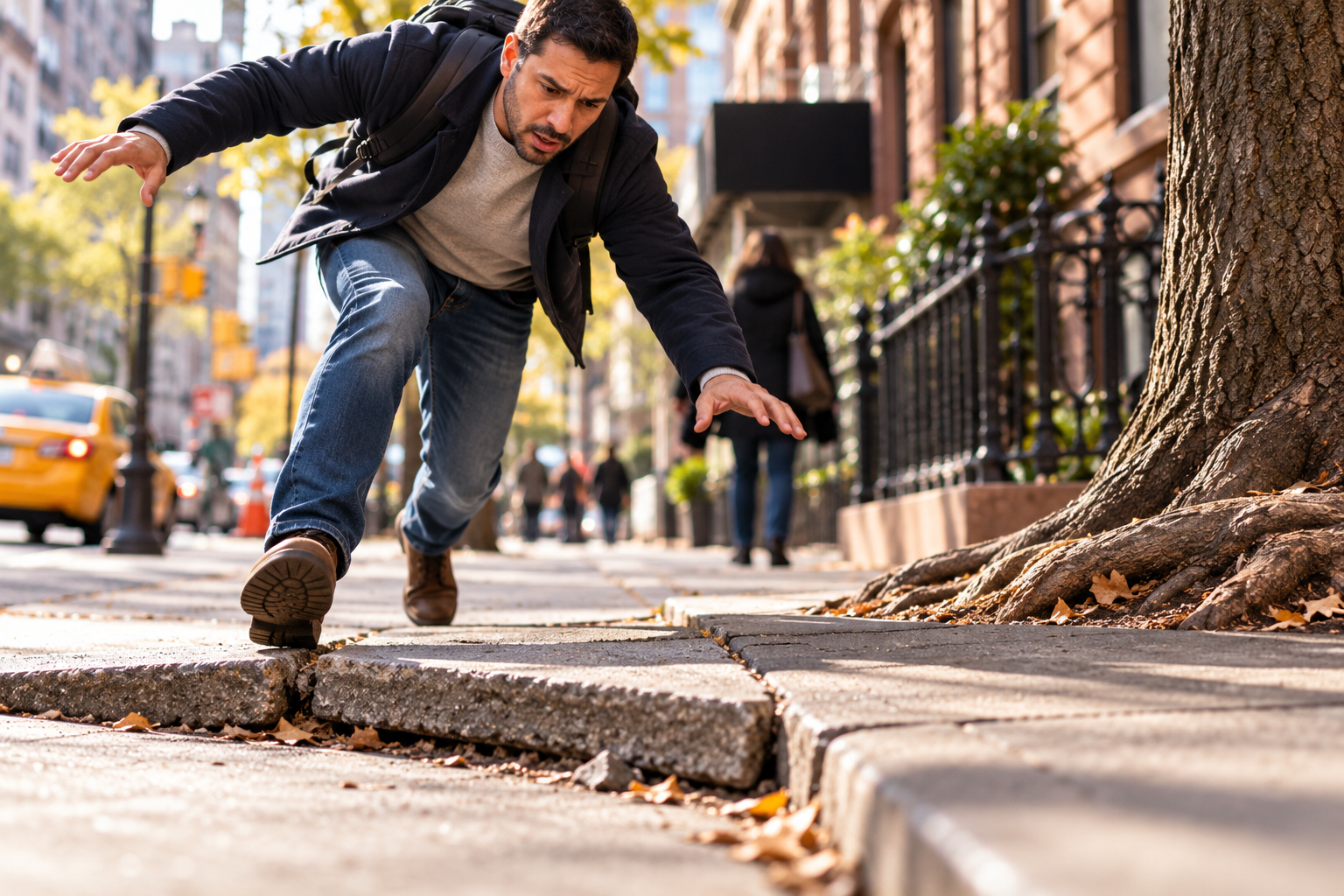
Raised sidewalk flags are everywhere in the five boroughs. Tree roots push slabs up, utility work leaves uneven patches, and years of wear create gaps and holes. Below, the attorneys at Cakani Law Firm, P.C. explain how New York law treats these falls, when you likely have a claim, and when you may not.
Commercial Property: The Owner Next Door Is Usually Responsible
Since September 14, 2003, Section 7-210 of the NYC Administrative Code has required owners of property abutting a sidewalk to keep it in a reasonably safe condition. The law shifted liability for sidewalk injuries from the City to those owners. Courts describe this duty as nondelegable, meaning the owner cannot avoid it by pointing to a tenant or a contractor.
In practice, if you fell on a raised flag in front of a store, office building, restaurant, warehouse, apartment building, or any other commercial property, your claim is usually against the property owner. Commercial tenants and managing agents may also share responsibility under a lease or if they caused the defect.
The owner’s duty covers more than raised flags. It includes cracked, broken, missing, or uneven sidewalk, and a failure to remove snow and ice. To win, we generally must show the owner created the defect or knew, or should have known, about it long enough to fix it.
When the City Is Responsible — and the Prior Written Notice Rule
The City of New York can still be the right defendant in several situations:
- Small owner-occupied homes: Section 7-210 does not apply to a one-, two- or three-family house that is at least partly owner-occupied and used only as a residence. A fall in front of such a home usually means a claim against the City.
- Curbs: Courts have held that the curb is not part of the sidewalk under Section 7-210, so the City remains responsible for curb defects.
- City tree wells: Section 7-210 does not make owners liable for City-owned tree wells, unless the owner created the condition, repaired it negligently, or made a special use of it.
- City-owned property: Sidewalks in front of City buildings, parks, and other City land.
Suing the City comes with an extra hurdle. Under Administrative Code Section 7-201(c), the City generally cannot be held liable for a sidewalk defect unless it received prior written notice of that specific defect before the accident. Courts treat this notice as a condition the injured person must plead and prove.
The most common source of prior written notice is the Big Apple Map. These maps, filed with the Department of Transportation by the Big Apple Pothole and Sidewalk Protection Corporation, mark raised flags, holes, and other defects with symbols. A marking at the exact spot where you fell can satisfy the rule. A marking for a different type of defect, or a different spot nearby, usually will not.
There are narrow exceptions. Prior written notice is not required if the City itself caused or created the defect through its own work, or if it made a special use of the sidewalk that benefited the City.
When You May Not Have a Case
Not every fall on a sidewalk leads to a recovery. These are the most common reasons claims fail:
- The defect is “trivial”: New York has no fixed minimum height, such as one inch. But courts can dismiss a case if the defect is so slight it would not trip a reasonable person. Size is weighed together with the surrounding circumstances, like lighting, crowds, weather, and whether the defect was hidden. A small defect can still be actionable in the right setting.
- No notice: In a City case, no prior written notice and no exception means no claim. Against a private owner, we must show the owner created the defect or had actual or constructive notice of it.
- The wrong defendant: Suing the owner when the City is responsible, or the reverse, can sink a case — especially once deadlines pass.
- You cannot say what caused the fall: If you do not know what you tripped on, a court may find the cause speculative. Photos and witnesses matter.
- Missed deadlines: Claims against the City have short, strict time limits.
Your own carelessness does not bar a claim. Under New York’s comparative fault rule, any damages are reduced by your share of fault, but you can still recover.
Deadlines You Cannot Miss
| Who Is Responsible | Key Deadline |
|---|---|
| City of New York | Notice of Claim within 90 days of the fall (General Municipal Law § 50-e); lawsuit within 1 year and 90 days (GML § 50-i). |
| Private or commercial property owner | Lawsuit generally within 3 years (CPLR 214). |
After a Notice of Claim, the City may also require you to attend a sworn examination, known as a 50-h hearing, before you can sue. Because it is not always clear at first who owns or controls a sidewalk, we recommend treating every case as if the 90-day deadline applies.
What to Do After a Sidewalk Fall
- Get medical care right away, and tell the provider exactly how you fell.
- Photograph the defect from several angles, with something for scale such as a coin, a key, or your shoe.
- Note the exact address or the nearest building number and cross street.
- Get names and phone numbers of any witnesses.
- Keep the shoes and clothing you wore.
- Do not give recorded statements to an insurance company before speaking with a lawyer.
- Call an attorney quickly, so the 90-day Notice of Claim deadline is protected if the City is involved.
Talk to Cakani Law Firm
Cakani Law Firm, P.C. represents people injured on sidewalks throughout New York City, including the Bronx, Manhattan, Brooklyn, Queens, and Staten Island, as well as Westchester. We have handled many sidewalk trip-and-fall cases against commercial property owners and the City of New York, and we know the rules that decide them, from Section 7-210 to prior written notice. We investigate who owns the property, pull Big Apple Maps and City records, and file the necessary notices on time.
Consultations are free, and you pay nothing unless we recover for you. Hablamos Español.
Contact Cakani Law Firm today.
cakanilaw.com
Call (212) 962-0500
This article is for general information only and is not legal advice. Every case depends on its own facts. Reading this article does not create an attorney-client relationship. Attorney Advertising.
Sources
- Landro v Abadiotakis, 2026 NY Slip Op 02258 (2d Dept, Apr. 15, 2026) — Section 7-210 shifts sidewalk liability to owners; curbs excluded.
- Coimin v City of New York, 2026 NY Slip Op 02244 — Owner-occupied one-, two- and three-family residential property exemption.
- Cuccia v City of New York, 22 AD3d 516 (2005) — Prior written notice under Section 7-201(c) and Big Apple Maps.

