
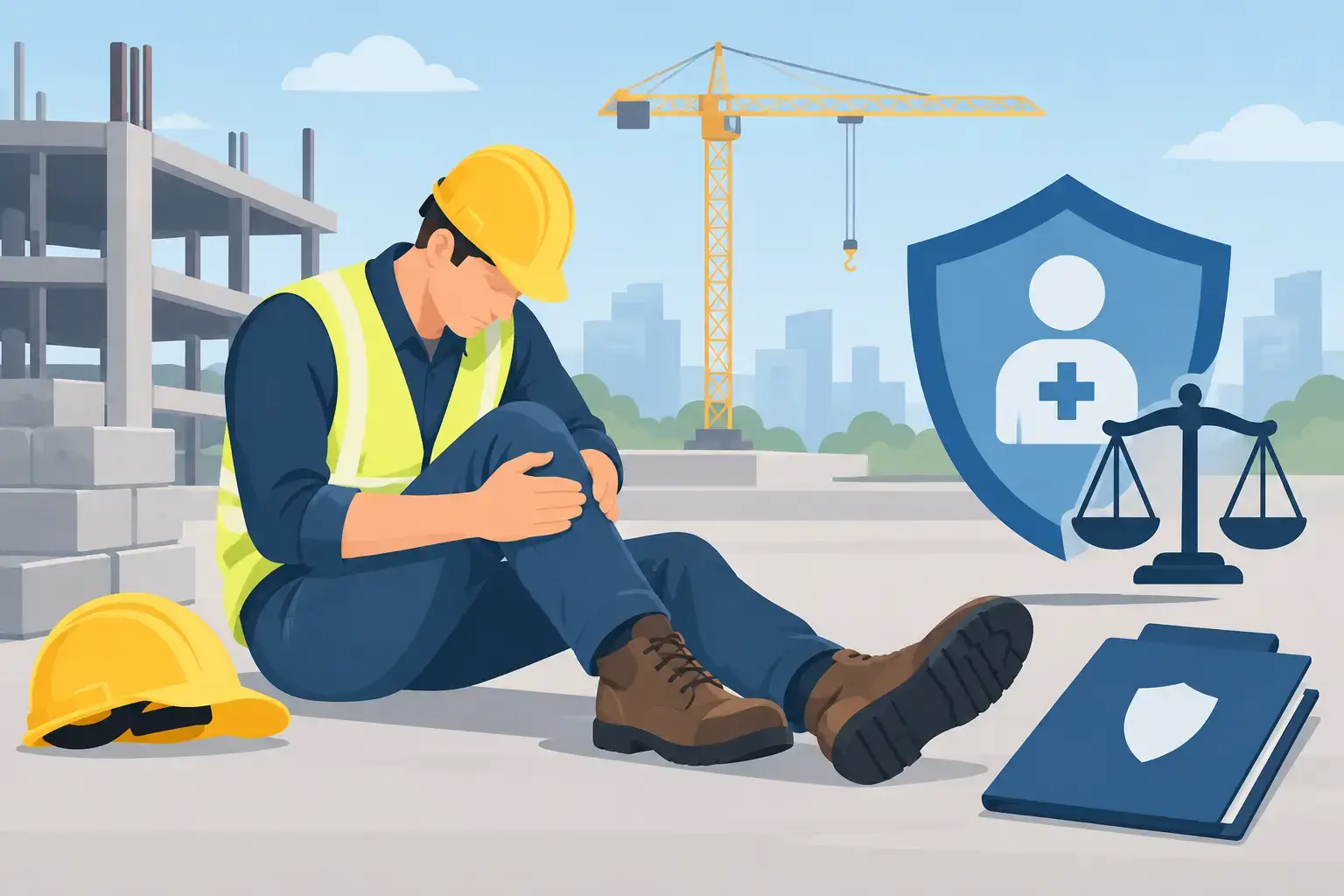
A fall from a scaffold, a collapsing trench, a defective saw, or a load dropped from above can change a worker’s life in seconds. This construction liability guide explains a critical point many injured workers do not learn until it is too late: workers’ compensation may be only one source of recovery. When a property owner, general contractor, subcontractor, equipment company, or another outside party caused or contributed to the danger, a separate personal injury claim may be possible.
The difference matters. Workers’ compensation can provide medical care and partial wage benefits, but it often does not fully account for a devastating injury, ongoing pain, lost earning capacity, or the impact on a family. Identifying every responsible party early can protect your ability to pursue the compensation you need to recover and move forward.
Construction Liability Guide: Who May Be Responsible?
Construction sites are crowded, fast-moving workplaces. Multiple companies may be working side by side, each with different responsibilities for safety, supervision, equipment, and site conditions. A worker may be employed by one subcontractor while being injured by a dangerous condition created by another company.
That is why responsibility is rarely as simple as asking who signed your paycheck. Depending on the facts, a claim may be brought against the property owner, general contractor, construction manager, another subcontractor, an equipment manufacturer, a delivery company, or a negligent driver entering the work zone.
For example, a laborer injured when unsecured materials fall from an upper floor may have a claim against the party responsible for securing the load or supervising the work. A worker hurt by a malfunctioning lift, scaffold, ladder, saw, or crane may have a claim involving defective equipment, poor maintenance, improper assembly, or inadequate training. A fall on debris, ice, uneven flooring, or an unprotected opening may point to unsafe site conditions and failures in inspection or cleanup.
The responsible parties may deny control over the work or blame the injured person. Their insurance companies begin protecting their own financial interests immediately. A serious construction case requires a close review of contracts, work logs, safety records, site photographs, witness accounts, and the roles each company had on the project.
New York Construction Accident Laws Can Be Powerful
New York law provides significant protections for many construction workers, particularly those injured in gravity-related accidents. These claims can be highly fact-specific, but three laws frequently arise in serious jobsite injury cases.
Labor Law Section 240(1): Falls and Falling Objects
New York Labor Law Section 240(1), often called the Scaffold Law, applies to certain elevation-related risks. It may protect workers who fall from scaffolds, ladders, roofs, platforms, lifts, or other elevated work areas. It can also apply when an object falls because it was not properly secured or did not have adequate safety devices.
This law does not mean every workplace fall automatically creates a claim. The task being performed, the height-related hazard, the safety equipment available, and the parties with legal responsibility all matter. But when an owner or contractor failed to provide proper protection, Section 240(1) can be a powerful path to accountability.
Labor Law Section 241(6): Unsafe Construction Conditions
Section 241(6) may apply to injuries caused by violations of specific New York Industrial Code safety rules. These cases often involve hazards such as unguarded openings, dangerous stairways, inadequate lighting, improper demolition practices, slippery work surfaces, or unsafe excavation work.
The exact regulation matters. A lawyer must connect the accident to a concrete safety requirement, not just a general allegation that the site was unsafe. That is one reason prompt investigation is so valuable.
Labor Law Section 200 and Negligence
Section 200 reflects an owner’s or contractor’s general duty to provide a reasonably safe workplace. A claim may arise where a party had authority over the work or knew, or should have known, about a dangerous condition. This can be especially important in cases involving site debris, defective premises conditions, unsafe work methods, and inadequate supervision.
New Jersey Claims Usually Turn on Negligence
New Jersey does not have a direct equivalent to New York’s Scaffold Law. A seriously injured New Jersey worker may still have a strong third-party claim, but the case generally requires proof that another party acted carelessly or failed to meet its safety obligations.
A general contractor that ignored known hazards, a subcontractor that created an unsafe condition, a property owner that failed to maintain the site, or a manufacturer that sold defective equipment may be held responsible. The evidence may include Occupational Safety and Health Administration findings, inspection reports, safety manuals, prior complaints, maintenance records, and expert analysis.
The absence of a Scaffold Law does not mean an injured worker has no case. It means the investigation must clearly establish what happened, who controlled the risk, and how proper safety practices could have prevented the injury.
Workers’ Compensation Is Not the Same as a Lawsuit
After a jobsite injury, workers’ compensation is usually the claim against your employer. In most situations, you cannot file a personal injury lawsuit directly against that employer. Workers’ compensation can pay for authorized medical treatment and provide wage-related benefits, regardless of who was at fault.
A third-party lawsuit is different. It targets someone other than the employer whose negligence, legal violation, or defective product caused the injury. Unlike workers’ compensation, a successful third-party claim may seek damages for pain and suffering, full lost earnings, reduced future earning ability, medical expenses, and other losses. In a wrongful death case, surviving family members may have additional claims.
These claims can proceed at the same time, but they affect each other. Workers’ compensation carriers may assert a lien against part of a third-party recovery. An experienced construction injury lawyer evaluates both claims together to avoid leaving money on the table and to pursue the strongest overall result.
Evidence Can Disappear Faster Than You Think
Construction sites change by the hour. A broken ladder can be removed. A hole can be covered. Scaffolding can be dismantled. Cameras may record over old footage, and witnesses may be sent to different jobs.
If you can do so safely, preserve photographs of the area, equipment, visible injuries, and the clothing or protective gear you were using. Keep the names and phone numbers of coworkers who saw what happened. Report the accident promptly and ask for a copy of any incident report. Do not alter, discard, or repair the equipment involved if it is in your control.
You should also seek prompt medical attention and clearly describe every body part that hurts. Serious trauma is not always obvious in the first hours after an accident. Back, neck, brain, shoulder, knee, and internal injuries can worsen over time. Gaps or vague records can later be used by insurers to argue that the injury was unrelated or less severe than it truly is.
Avoid signing broad statements, recorded interviews, medical authorizations, or settlement documents from an insurer before understanding what they mean. A quick payment may be designed to close a claim before the full extent of your injuries, treatment needs, and lost income is known.
What a Serious Construction Claim Requires
High-value construction cases are not built on a demand letter alone. They often require site inspections, engineering analysis, construction safety experts, medical specialists, vocational experts, and economists who can explain the long-term financial damage caused by a disabling injury.
The right legal team investigates the physical cause of the accident and the human cost. That includes future surgeries, rehabilitation, chronic pain, inability to return to the trade, household responsibilities your family now carries, and the income you may lose over decades. Insurance companies have lawyers and experts ready to challenge every part of the case. Injured workers deserve representation prepared to meet that fight with facts, resources, and resolve.
When to Speak With a Construction Injury Lawyer
You should seek legal guidance quickly after a fall, struck-by accident, crush injury, electrocution, burn, machinery accident, trench collapse, or any injury that keeps you from working. Time limits apply, and some claims involving public entities have especially short notice requirements. Waiting can make it harder to preserve the proof needed to establish liability.
At The Cakani Law Firm, P.C., we represent seriously injured workers and families across New York and New Jersey, including cases other firms may not have the resources to pursue. We do not charge attorney fees unless we win. A prompt case evaluation can identify the parties responsible, preserve critical evidence, and give you a clearer path forward while you focus on healing.

