
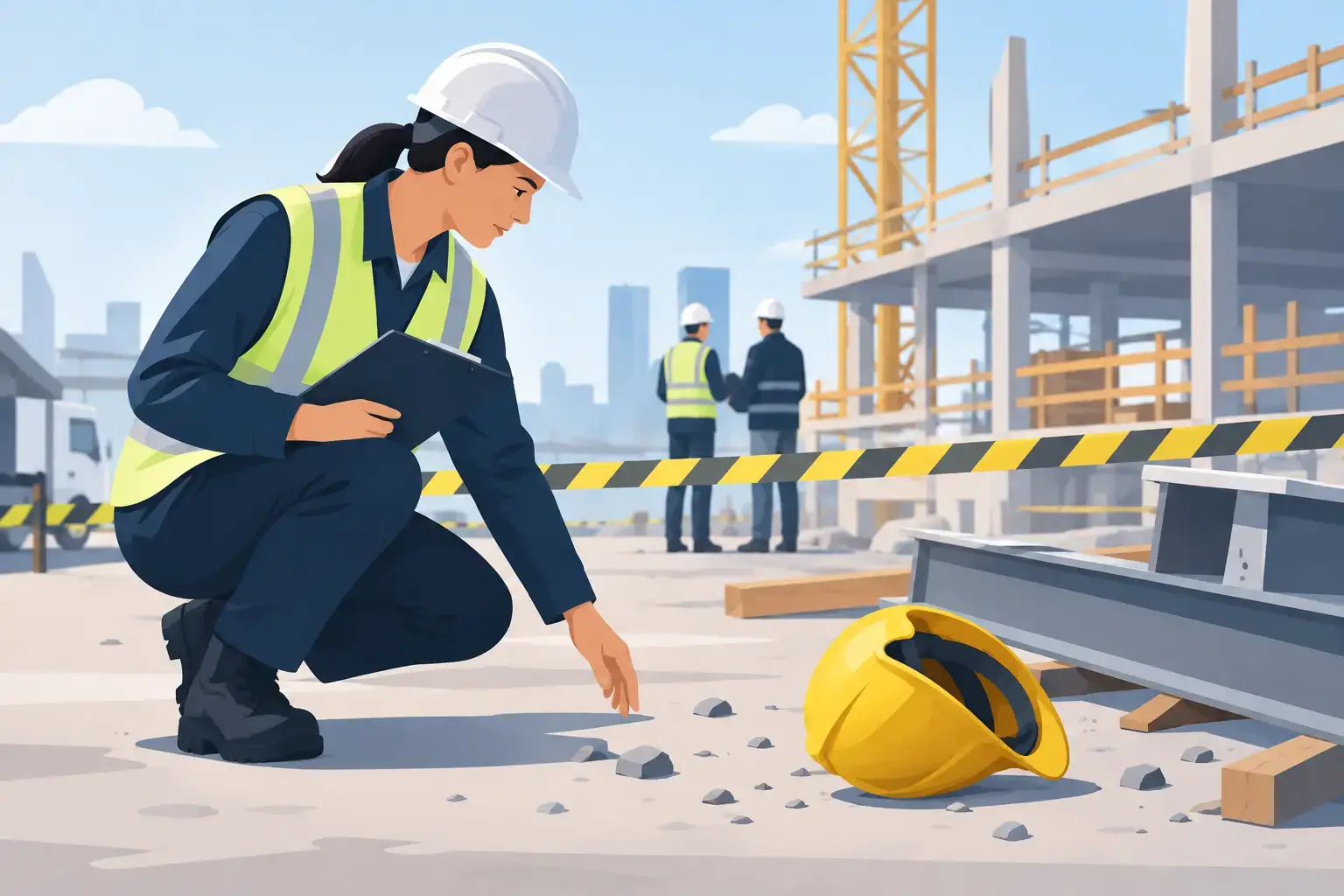
A serious job-site injury creates more than pain and missed paychecks. It creates a race to establish what happened before a damaged ladder disappears, a scaffold is altered, video is overwritten, or witnesses are pressured to move on. If you are asking who investigates construction accidents, the answer is often several parties at once, each with a different purpose and different level of urgency.
Government investigators may look for safety violations. Employers and insurance carriers may protect their own financial interests. Police may investigate when a crash, fatality, or possible criminal conduct is involved. A construction accident lawyer investigates to identify every responsible party and preserve the evidence needed to pursue full compensation.
Who Investigates Construction Accidents After a Serious Injury?
The first people to investigate are often the employer, general contractor, or site safety personnel. They may prepare an incident report, photograph the area, interview workers, and notify their insurance carrier. That report can matter, but it is not necessarily a neutral account. The company preparing it may have a strong incentive to minimize unsafe conditions, shift blame to an injured worker, or characterize a preventable event as an unavoidable accident.
A workers’ compensation carrier will also investigate because it may be responsible for medical and wage-loss benefits. Its focus is usually narrow: whether the injury happened in the course of employment, the extent of medical treatment, and what benefits are owed. Workers’ compensation is vital, but it generally does not pay for pain and suffering. It may not uncover whether a property owner, general contractor, subcontractor, equipment company, or another outside party created the danger.
When the incident involves an apparent workplace safety violation, the Occupational Safety and Health Administration, or OSHA, may conduct an investigation. OSHA can inspect the site, interview employees, review records, and issue citations or penalties. In New York, workplace safety enforcement may also involve state agencies, particularly on public projects or in circumstances outside federal OSHA coverage.
OSHA does not investigate every construction injury. The agency prioritizes fatalities, catastrophic events, and reports of serious hazards. Employers must report a work-related fatality within eight hours and report certain serious injuries, including inpatient hospitalizations, amputations, and losses of an eye, within 24 hours. Even then, an OSHA investigation may not begin immediately, and the agency’s findings do not automatically determine who is legally liable in a civil injury claim.
Police, fire marshals, and other local authorities may become involved after a fatal fall, a crane collapse, an explosion, a trench collapse, an electrocution, or an accident involving a vehicle. Their work can establish critical facts, but their mission is public safety and, where appropriate, criminal enforcement. They do not build a civil case for the injured worker or surviving family.
The Investigation That Is Often Missing
The injured worker needs an independent investigation focused on accountability. That may require immediate site photographs, witness interviews, inspection of the equipment involved, review of contracts and safety plans, and consultation with construction safety and engineering experts.
On a large project, responsibility is often spread across multiple companies. The owner may control the property. A developer may manage the project. A general contractor may coordinate trades. A subcontractor may direct a crew, while a separate company owns or supplied the equipment. The fact that one company employed you does not mean it was the only party that contributed to your injury.
What Each Investigation Can and Cannot Do
An employer investigation may identify the crew, the location, and the immediate sequence of events. It can also leave out the conditions that made the incident likely: a rushed schedule, missing guardrails, inadequate fall protection, poor housekeeping, defective tools, insufficient training, or a supervisor’s instruction to proceed despite an obvious danger.
OSHA findings can be persuasive evidence of unsafe practices. However, OSHA’s role is regulatory. A citation may be challenged, reduced, or resolved later. Conversely, the absence of a citation does not prove the site was safe or eliminate a personal injury claim.
Insurance investigations are designed to evaluate exposure and control costs. Adjusters may request recorded statements or broad medical authorizations early, when an injured worker is still in shock, medicated, or unsure of the diagnosis. You are not required to let an insurer define the facts before you understand your rights.
An independent legal investigation asks different questions. Was the ladder secured and appropriate for the task? Was required fall protection available and properly installed? Did debris, poor lighting, or an unprotected opening cause the fall? Was the scaffold defective or improperly assembled? Did a contractor ignore a prior complaint? Were workers given unsafe instructions to save time?
Those questions matter because construction cases can involve remedies beyond workers’ compensation. In New York, Labor Law protections may apply in cases involving gravity-related falls, falling objects, scaffolds, ladders, hoists, and certain unsafe construction conditions. New Jersey claims depend heavily on the facts, including who controlled the work and whether a third party created or failed to correct the hazard. The law is fact-specific, which is exactly why evidence must be secured early.
Evidence Can Disappear Before Any Agency Arrives
Construction sites change fast. A general contractor may repair the opening someone fell through before the end of the day. A broken saw can be removed. A lift may be returned to the rental company. Surveillance footage may be recorded over. The people who saw the accident may be assigned to another job weeks later.
That is why an injured worker or family should document what they can without putting themselves at risk. Keep photographs of injuries, the location, equipment, clothing, and visible conditions if they are available. Write down the names of coworkers, supervisors, and anyone who saw the incident. Save texts, job assignments, pay records, medical paperwork, and any accident report you receive.
Do not alter the equipment, and do not take property from the site. Instead, act quickly to have the relevant evidence preserved through the proper legal process. In a high-stakes construction case, counsel may send preservation notices and pursue access to the site, equipment, contracts, safety records, training materials, inspection logs, and video before key proof is lost.
Why Witness Accounts Matter
A report prepared hours after an accident may state that a worker “lost balance” or “failed to use available protection.” That language can obscure the real issue. Why did the worker lose balance? Was the surface slippery? Was the ladder unsecured? Was the worker required to carry materials while climbing? Was the available protection defective, inaccessible, or incompatible with the task?
Coworkers may have answers that do not appear in a company report. Yet many workers fear retaliation or believe they should not get involved. A careful investigation gives witnesses an opportunity to describe what they saw and what they knew about the conditions before the accident.
What to Do After a Construction Accident
Your health comes first. Get prompt medical care and follow through with treatment. Serious injuries, including traumatic brain injuries, spinal damage, internal injuries, crush injuries, burns, and orthopedic injuries, are not always fully apparent at the scene.
Report the incident promptly, but be accurate. Do not guess about facts you do not know, and do not sign a statement that blames you for conditions you did not create. If you receive workers’ compensation paperwork, meet deadlines while also considering whether another party may be responsible.
Speak with a lawyer promptly when the injury is serious, a loved one was killed, the site has already been changed, or an insurer is seeking a recorded statement. The right legal team has the resources to retain qualified experts and confront powerful owners, contractors, insurers, and equipment companies. At The Cakani Law Firm, P.C., we investigate serious injury cases with the urgency they demand and do not charge attorney fees unless we win.
No agency, employer, or insurance company is obligated to build the strongest possible case for an injured worker. The sooner the right people start asking hard questions and preserving proof, the better chance you have to protect your family, your future, and the full value of your claim.

